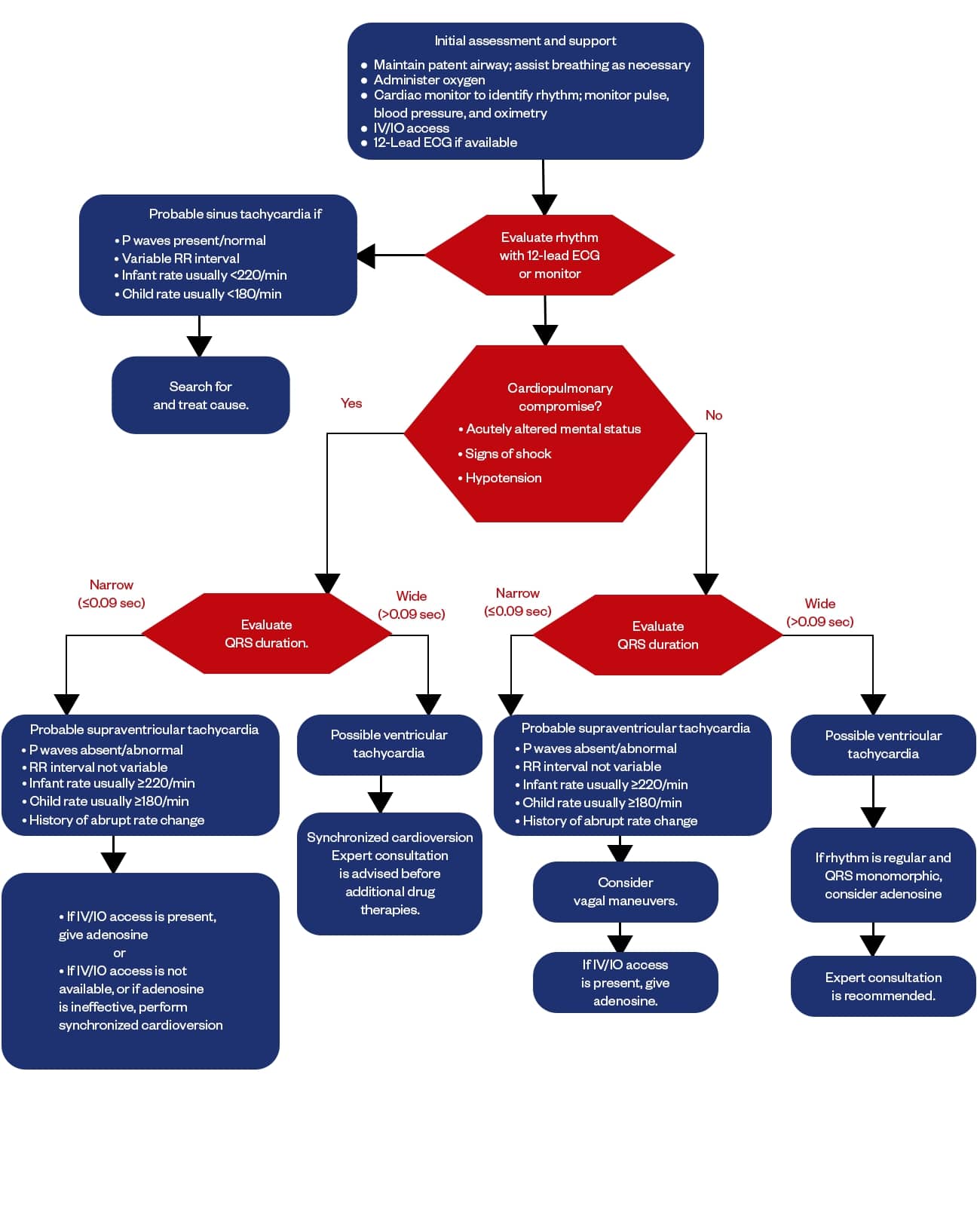
Step-by-step treatment algorithms

Pediatric Age-specific Normal Heart Rate

Since heart rate varies significantly with age, it is essential to consider age-specific thresholds when identifying tachycardia for effective pediatric tachycardia treatment.

Early recognition of tachycardia is crucial as fast heart rates can be a response to factors like fever, pain, discomfort, or anxiety, or sometimes indicate serious underlying heart diseases. Hence, a systematic guideline is needed that facilitates immediate and evidence-based treatment. That’s where PALS tachycardia algorithm comes into action.

PALS Tachycardia Algorithm

The first step includes the initial assessment of the patient’s condition and stabilizing if unstable. It includes:

1. ABC evaluation: Check for and ensure airway management, proper breathing, and circulation.

2. IV/IO access: Establish Intravenous (IV) or Intraosseous (IO) access as soon as possible.

3. Signs of shock: Assess if there are signs of shock, like poor perfusion, altered mental status, or hypotension.

4. Identification of Underlying Cause: Look for any underlying or reversible causes for tachycardia and address them as soon as possible to prevent complications.

The PALS treatment algorithm for tachycardia depends on the type of rhythm that differentiates Sinus tachycardia, SVT, and VT. So, proper rhythm analysis is performed with ECG findings and cardiopulmonary evaluation. It includes:

1. Obtain a 12-lead electrocardiogram (ECG) to determine rhythm type and QRS width.

2. Evaluate QRS Duration and rhythm.
• If narrow QRS (<0.09), it suggests Sinus Tachycardia or Supra Ventricular Tachycardia (SVT)
• If wide QRS (>0.09), it means Ventricular Tachycardia (VT)

3. Check for cardiopulmonary, like hypotension, altered mental status, or signs of shock.
• If the condition is unstable, perform synchronized cardioversion immediately.
• If stable with monomorphic wide QRS, administer adenosine.

After knowing the type of tachycardia, the immediate initiation of the appropriate medical intervention and treatment is essential. It includes:

1. Vagal maneuvers: Perform the vagal maneuvers immediately for Supraventricular tachycardia (SVT) cases to maintain the normal heart rhythm.
2. Adenosine: Administer adenosine if ventricular tachycardia (VT) is suspected and after vagal maneuvers in SVT.
• First dose: 0.1 mg/kg (maximum – 6 mg)
• Second dose: If the first dose is ineffective, 0.2 mg/kg (maximum – 12 mg)
3. Amiodarone or Procainamide: If adenosine is not effective, and there is pulseless ventricular tachycardia/ ventricular fibrillation (VT/VF), administer amiodarone or procainamide for stable and wide QRS to be able to treat with adenosine.
Note: Slow intravenous (IV) infusion and avoid providing both amiodarone and procainamide together due to the risk of hypotension and prolonged QT.
4. Synchronized Cardioversion: If adenosine is ineffective or not feasible due to irregular or polymorphic wide-complex tachycardia, immediately consider synchronized cardioversion.

It is crucial to monitor the condition of the patient consistently and carefully to provide appropriate intervention and support during the treatment process. It includes the following measures:

  1. Check the patient’s condition and vital signs at all times.
  2. Use a continuous electrocardiogram (ECG), pulse oximeter, and blood pressure monitoring.
  3. Keep a record of changes in rhythm or stability.
  4. Be prepared in case the patient’s condition gets worse.
  5. Maintain the oxygen or fluid levels and airway management.

5. Expert Consultation and Transfer

It is always essential to involve pediatric cardiology or a specialist, whether the condition of tachycardic children is improving or not. It ensures improved recovery and prevents potential long-term complications. That’s why a timely transfer to an expert and intensive care facility is needed. It includes:

  1. Request for expert assistance as early as possible.
  2. Providing details of assessment, ECG findings, and treatments administered.
  3. Continuous monitoring and support throughout the treatment.
  4. Ensure the transfer team is equipped for advanced pediatric care.

The Pediatric Tachycardia Algorithm is a systematic approach to treating pediatric tachycardic patients. It guides doctors, nurses, specialists and experts involved in the children’s healthcare from basic airway, breathing, circulation (ABC) evaluation to the advanced treatment like adenosine and synchronized cardioversion. It focuses on early initial assessment, immediate medical intervention, and continuous monitoring and support.

Healthcare professionals are required to learn PALS skills and get certified to remain compliant with their work, and even laypeople can hugely benefit by taking the PALS certification. PALS courses equip you with in-depth knowledge and hands-on skills on different treatment algorithms and prepare you to handle real pediatric emergencies confidently. If you are looking for a reliable training center, trust CPR VAM to offer you the comprehensive CPR courses like BLS, PALS, and ACLS.

Enroll today and boost your emergency preparedness!
These are advanced medications which are given only in case of confirmed ventricular tachycardia (VT) or when adenosine is ineffective. It needs high caution, like frequently monitoring blood pressure, ECG findings, QT levels and avoiding both medications together to prevent hypotension and arrhythmias.

The common mistakes are:
• Confuse VT for SVT and give adenosine inappropriately.
• Delay synchronized cardioversion in unstable children.
• Not addressing underlying causes on time.
• Ignore age-specific heart rate limits.
• Neglecting continuous monitoring throughout the treatment.

Yes, tachycardia can recur even after treatment if the underlying causes exist and are left unaddressed. That’s why early identification, continuous monitoring, proper evaluation of ECG findings, timely expert consultation and specialized care are necessary.

Yes, dehydration or fever can cause tachycardia, especially sinus tachycardia. Such underlying causes should be identified and treated first before jumping to antiarrhythmic medications like amiodarone or procainamide. Only if the patient remains unstable, the needed treatment be initiated immediately.

Rhythm can change during treatment, specifically after administering adenosine or synchronized cardioversion. That’s why rhythm and stability assessment are required after every intervention for recognizing the changes early and facilitating appropriate treatment on time.