

CPRvam Students
25,000+ students successfully trained annually
Step-by-step treatment algorithms
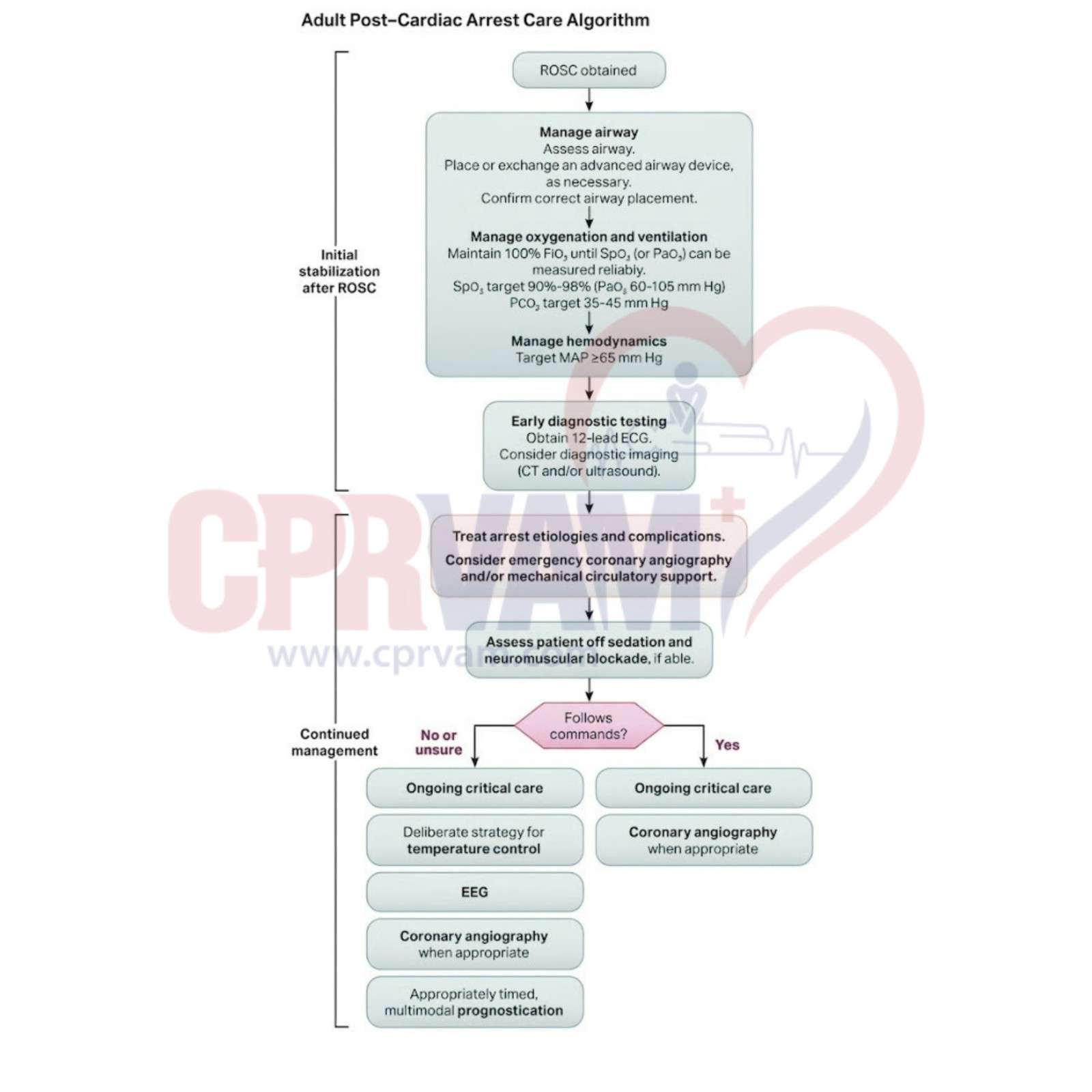
Adult post-cardiac arrest care algorithm flowchart

When a patient achieves return of spontaneous circulation (ROSC) after cardiac arrest, the emergency phase is not yet over. This stage is known as post–cardiac arrest care following ROSC. According to the American Heart Association (AHA), early, structured management in the initial hours is essential for improving survival outcomes and minimizing neurological injury.

The Adult Post–Cardiac Arrest Care Algorithm outlines a systematic, step-by-step approach to stabilizing the patient and addressing underlying causes.

Once circulation returns, the patient remains critically unstable and at high risk of deterioration. Immediate post–cardiac arrest care must begin without delay to stabilize vital functions and prevent complications.

  • Confirm return of pulse and spontaneous circulation
  • Initiate post–cardiac arrest protocol immediately
  • Transfer to ICU-level continuous monitoring
  • Continue cardiopulmonary support and reassessment
  • Activate the multidisciplinary critical care team

A secure airway is essential after cardiac arrest. It ensures adequate oxygen delivery to the brain. It also prevents complications such as aspiration, obstruction, and airway collapse.

  • Assess airway patency and breathing effectiveness
  • Insert or confirm an endotracheal or advanced airway
  • Verify placement using waveform capnography
  • Prevent aspiration and airway collapse
  • Maintain continuous airway security

Both low oxygen and excessive oxygen can worsen neurological outcomes. Controlled ventilation is required after cardiac arrest. Oxygen levels must be carefully monitored to avoid hypoxia and hyperoxia.

  • Maintain SpO₂ between 90% and 98%
  • Target PaO₂ between 60-105 mmHg
  • Maintain PaCO₂ between 35-45 mmHg
  • Gradually titrate oxygen after stabilization
  • Avoid hypo-ventilation and hyperventilation

Stable blood pressure is essential after cardiac arrest. It ensures adequate oxygen delivery to vital organs, especially the brain and heart. Maintaining perfusion helps prevent organ dysfunction and complications.

  • Maintain mean arterial pressure (MAP) ≥ 65 mmHg
  • Administer IV fluids when indicated
  • Initiate vasopressors for persistent hypotension
  • Monitor tissue perfusion and lactate levels
  • Prevent shock-related organ injury

Rapid identification of the underlying cause of cardiac arrest is essential. It guides targeted treatment strategies. Early diagnosis also improves patient outcomes and reduces the risk of recurrence.

  • Perform an immediate 12-lead ECG
  • Use bedside echocardiography or ultrasound
  • Conduct CT imaging if clinically indicated
  • Identify reversible causes (H’s and T’s)
  • Assess for trauma, bleeding, or systemic causes

Once the cause of cardiac arrest is suspected, it must be treated urgently. Immediate intervention helps prevent recurrence. It also reduces the risk of further organ damage.

  • Treat reversible metabolic or cardiac causes
  • Perform emergency coronary angiography when indicated
  • Manage cardiogenic shock aggressively
  • Treat life-threatening arrhythmias
  • Initiate mechanical circulatory support if required

Neurological evaluation is performed after stabilization. It helps determine brain function and level of recovery. It also guides prognosis and future treatment decisions for the patient.

  • Assess the level of consciousness
  • Evaluate the ability to follow simple commands
  • Exclude effects of sedation or paralysis
  • Establish neurological baseline status
  • Prepare for ongoing neurological monitoring

This step determines the next phase of care after ROSC by evaluating whether the patient has meaningful neurological recovery, specifically the ability to follow commands.

  • Assess if the patient can follow simple verbal commands
  • Rule out effects of sedation or neuromuscular blockade
  • Reassess neurological status at regular intervals
  • Determine the pathway based on the response

Decision Pathway (Neurological Responsiveness Assessment)

8.1.1. Recovery-Oriented Management)

When the patient follows commands after ROSC, care focuses on stabilization, identifying the cause of arrest, and gradual recovery with reduced intensive support.

  • Continue critical care with stable oxygen, ventilation, and blood pressure
  • Identify and treat the underlying cardiac cause of arrest
  • Gradually shift toward recovery and step-down care when stable

8.1.2. Coronary Evaluation in Recovery Pathway (Selective Assessment)

Coronary assessment is done in a targeted way to identify and treat reversible cardiac causes, especially ischemia-related conditions.

  • Perform a coronary evaluation when clinically indicated (ECG changes or symptoms)
  • Use angiography in suspected STEMI or acute coronary syndrome
  • Perform PCI if significant coronary blockage is found to restore blood flow

8.2.1. Intensive Care Management

Patients who do not follow commands require immediate ICU-level support to stabilize vital organ systems and prevent secondary brain injury.

  • Provide continuous critical care and close monitoring
  • Maintain airway protection, breathing, and circulation support
  • Initiate full post-cardiac arrest stabilization protocol

8.2.2. Temperature Control Strategy

Targeted temperature management helps limit neurological injury and improves overall survival after cardiac arrest.

  • Maintain controlled temperature between 32°C and 37.5°C
  • Prevent fever to reduce further brain damage
  • Use controlled cooling followed by gradual rewarming

8.2.3. Neurological Monitoring with EEG

EEG is essential for detecting hidden brain dysfunction and seizure activity that may not be clinically visible.

  • Continuous or scheduled EEG monitoring
  • Detect non-convulsive seizures early
  • Guide timely anti-seizure treatment and management

8.2.4. Multimodal Neurological Prognostication

Neurological recovery is assessed cautiously using multiple diagnostic methods after adequate stabilization.

  • Perform assessment ≥72 hours after ROSC or normothermia
  • Combine EEG, imaging, and clinical examination findings
  • Avoid premature or inaccurate outcome prediction

8.2.5. Coronary Angiography & Cardiac Evaluation

This step identifies and treats underlying cardiac causes of arrest, particularly ischemic heart disease in unstable patients.

  • Urgent evaluation of suspected cardiac ischemia
  • Consider angiography in shock or hemodynamic instability
  • Perform PCI to restore coronary blood flow and perfusion

The Adult Post–Cardiac Arrest Care Algorithm provides a structured approach after ROSC. It ensures rapid stabilization, brain protection, and timely treatment to improve survival and neurological recovery.

  1. Provides a Clear Step-by-Step Clinical Framework

    It gives healthcare teams a structured sequence of actions after cardiac arrest. This reduces confusion and ensures faster, more organized decision-making in critical situations.

  2. Ensures Immediate Physiological Stabilization

    The algorithm prioritizes airway, breathing, circulation, and oxygen delivery. This helps stabilize vital organs, especially the brain and heart, in the first hours after ROSC.

  3. Prevents Secondary Complications After ROSC

    It helps avoid complications like low oxygen, low blood pressure, and recurrent arrest. Continuous monitoring reduces preventable deterioration after initial resuscitation.

  4. Supports Timely Diagnosis and Treatment of the Cause

    The algorithm encourages early testing, such as ECG and imaging, to find the cause of arrest. Treating the underlying problem helps prevent recurrence and improves outcomes.

  5. Protects the Brain and Improves Neurological Outcomes

    It includes strategies like temperature control and EEG monitoring. These steps reduce brain injury and increase the chances of meaningful neurological recovery.

  6. Standardizes High-Quality Critical Care

    It ensures all patients receive consistent, evidence-based care regardless of location. This improves teamwork, reduces errors, and enhances overall treatment quality.

  7. Improves Survival and Long-Term Recovery Outcomes

    Structured post-arrest care increases survival rates and improves brain function recovery. It also supports better long-term health and rehabilitation outcomes.
The Adult Post-Cardiac Arrest Care Algorithm provides a structured approach after ROSC, focusing on stabilization, brain protection, and treatment of underlying causes. It guides timely, coordinated actions that improve survival and neurological outcomes in critical patients.

This algorithm ensures systematic ICU care with airway management, hemodynamic support, targeted temperature control, and early diagnosis. For clinicians and students, CPR VAM Training Center offers training in BLS, ACLS, and PALS courses, helping build strong emergency care skills based on updated AHA guidelines.

Continuous monitoring helps detect early changes in heart rhythm, blood pressure, and oxygen levels. This allows immediate intervention before the patient’s condition worsens.

Brain injury is reduced by maintaining stable oxygen levels, blood pressure, and controlled body temperature. These measures help protect brain cells from further damage after resuscitation.

Imaging helps identify hidden causes such as stroke, internal bleeding, or heart blockages. It guides doctors in choosing the most appropriate treatment quickly and accurately.

Sedation can temporarily suppress brain responses and give misleading results. Therefore, assessment is done only after its effects wear off to ensure accurate neurological findings.

A structured approach ensures no critical step is missed during management. This improves survival chances and increases the likelihood of meaningful neurological recovery.


Advanced Cadiovascular Life Support