CPRvam Students
25,000+ students successfully trained annually
Step-by-step treatment algorithms
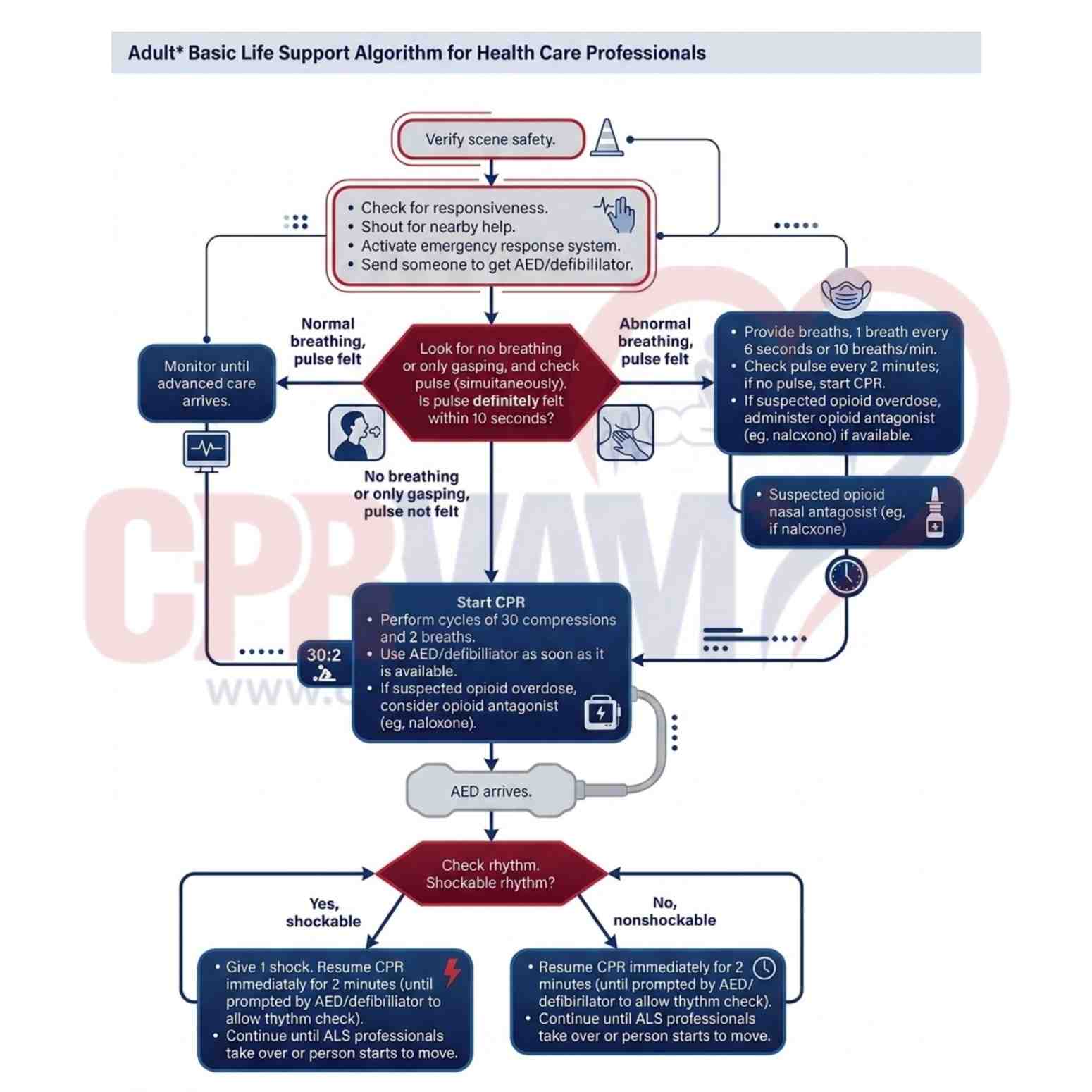
Flowchart of adult basic life support steps for emergencies

Life-threatening emergencies require immediate action. Start Adult Basic Life Support (BLS) if an adult is unresponsive, not breathing, or in severe distress. Follow 2025 AHA BLS guidelines for rapid, effective response.

  1. Cardiac Arrest: Start CPR Immediately
    When the heart stops and the adult is unresponsive, begin CPR immediately. Perform 30 compressions and 2 rescue breaths. Use an AED as soon as possible to preserve brain and organ function.

  2. Stroke Emergency: Respond Fast
    BLS can’t reverse a stroke, but act immediately if the person becomes unresponsive or stops breathing. Begin CPR, call for help, and prepare an AED for life-saving support.

  3. Respiratory Failure: Support Breathing Quickly
    If someone stops breathing or struggles severely, provide rescue breaths. Give 1 breath every 6 seconds if the pulse is present. Begin full CPR cycles if the pulse is absent.

  4. Choking or Airway Obstruction: Clear and Act
    For a blocked airway, perform abdominal thrusts. If the person becomes unresponsive, start CPR immediately and call for help. Fast action prevents brain injury and increases survival chances.

  5. Drowning Victim: Immediate Rescue Needed
    Remove the unresponsive or non-breathing victim from water and begin CPR immediately. Use an AED as soon as possible. Prompt intervention reduces the risk of brain damage.

  6. Severe Allergic Reaction: Act on Anaphylaxis
    If airway swelling, breathing difficulty, or fainting occurs and the person becomes unresponsive, start chest compressions, call for help, and use an AED if available to maintain oxygen flow.

  7. Drug Overdose: Begin Life Support Quickly
    Check breathing and pulse for an unresponsive overdose victim. Begin BLS immediately, call for help, and administer naloxone if trained. Start full CPR cycles if the pulse is absent.

  8. Major Trauma or Burns: Stabilize Immediately
    For unresponsive adults after accidents, burns, or trauma, ensure the scene is safe. Begin BLS immediately to stabilize vital organs until advanced medical care arrives.

While BLS can save lives, there are situations where it should not be initiated. Recognizing these scenarios ensures safety, respects legal directives, and prevents futile resuscitation efforts.

  1. Signs of Life: Breathing or Movement Present
    If the adult is breathing normally, moving, or responsive, BLS is unnecessary. Starting CPR in this situation may cause harm instead of benefit and should be avoided.

  2. Unsafe Environment: Protect Yourself First
    Do not begin BLS if the scene is dangerous, such as near fire, traffic, electrical hazards, or violence. Ensure your own safety before assisting others.

  3. Obvious Death: Resuscitation May Be Futile
    If the person shows clear signs of death, such as rigor mortis, decapitation, or irreparable injuries, BLS is unlikely to succeed and should not be attempted.

  4. Do Not Resuscitate (DNR) Orders: Respect Legal Directives
    If a legally binding DNR order exists, BLS or CPR must not be performed. Healthcare providers and responders must follow these instructions to honor patient wishes.


Even minor errors during Basic Life Support (BLS) can reduce survival chances. Understanding common pitfalls and how to avoid them ensures effective, timely, and safe resuscitation for adults in emergencies.

  1. Delaying Emergency Services: Call for Help Immediately
    Always activate emergency response systems and call 911 without hesitation. Early professional assistance improves survival and allows the timely arrival of advanced care and an AED.

  2. Incorrect Hand Placement: Position for Effective Compressions
    Place your hands at the center of the victim’s chest, on the lower half of the sternum. Proper positioning ensures compressions reach the heart effectively, improving blood flow to vital organs.

  3. Skipping AED Use: Utilize Defibrillators Promptly
    Automated External Defibrillators (AEDs) are lifesaving and simple to use. Do not delay their use. Follow the prompts and include them in CPR cycles as soon as they are available.

  4. Improper Compression Rate: Maintain 100-120 Per Minute
    Keep chest compressions at 100-120 per minute. Too slow or too fast reduces circulation effectiveness, lowering oxygen delivery to the brain and vital organs.

  5. Interrupting CPR Too Soon: Continue Without Unnecessary Pauses
    Do not stop CPR until professional help arrives or the person shows clear signs of recovery. Continuous compressions maximize survival chances.

  6. Failing to Open the Airway: Ensure Effective Breathing
    Tilt the head back and lift the chin before rescue breaths. Proper airway positioning allows breaths to enter the lungs and improves oxygen delivery.

  7. Improper Assessment: Check Responsiveness and Breathing Quickly
    Rapidly evaluate whether the person is responsive and breathing normally. Accurate assessment guides correct BLS steps and avoids unnecessary or delayed interventions.

The Adult Basic Life Support (BLS) Algorithm is more than just a set of steps. It is a proven, systematic approach that can save lives in critical moments. Each phase of the algorithm is designed to support the chain of survival by ensuring safety, recognizing unresponsiveness, assessing breathing and pulse, providing immediate high-quality CPR, and using an AED without delay. When performed correctly and quickly, these actions significantly increase the chances of restoring normal heart function and preventing brain damage.

That’s why it is important to review your BLS skills regularly, keep up with the latest American Heart Association (AHA) updates, and practice the steps often so you’re ready when it counts. Learning life-saving skills with a certified course offered by CPR VAM is a practical way to stay prepared and confident in emergencies.

The Adult BLS Algorithm is a structured set of steps used to respond to cardiac arrest and other life-threatening emergencies. It guides rescuers in performing CPR, assessing breathing and pulse, and using an AED effectively.

CPR should begin immediately if the victim is unresponsive and has no normal breathing or pulse. Early CPR helps maintain blood flow to vital organs until advanced care arrives.

You should check breathing and carotid pulse at the same time within 10 seconds. Look for normal breathing, listen carefully, and feel for a pulse using two fingers on the neck.

Turn on the AED immediately and follow its voice prompts for pad placement and rhythm analysis. Resume CPR right after delivering a shock or if no shock is advised.

A shockable rhythm is a heart rhythm that can be corrected using a defibrillator shock. The AED automatically detects this and instructs you when to deliver a shock.

how to renew aha bls certification
Basic Life Support