

CPRvam Students
25,000+ students successfully trained annually
Step-by-step treatment algorithms
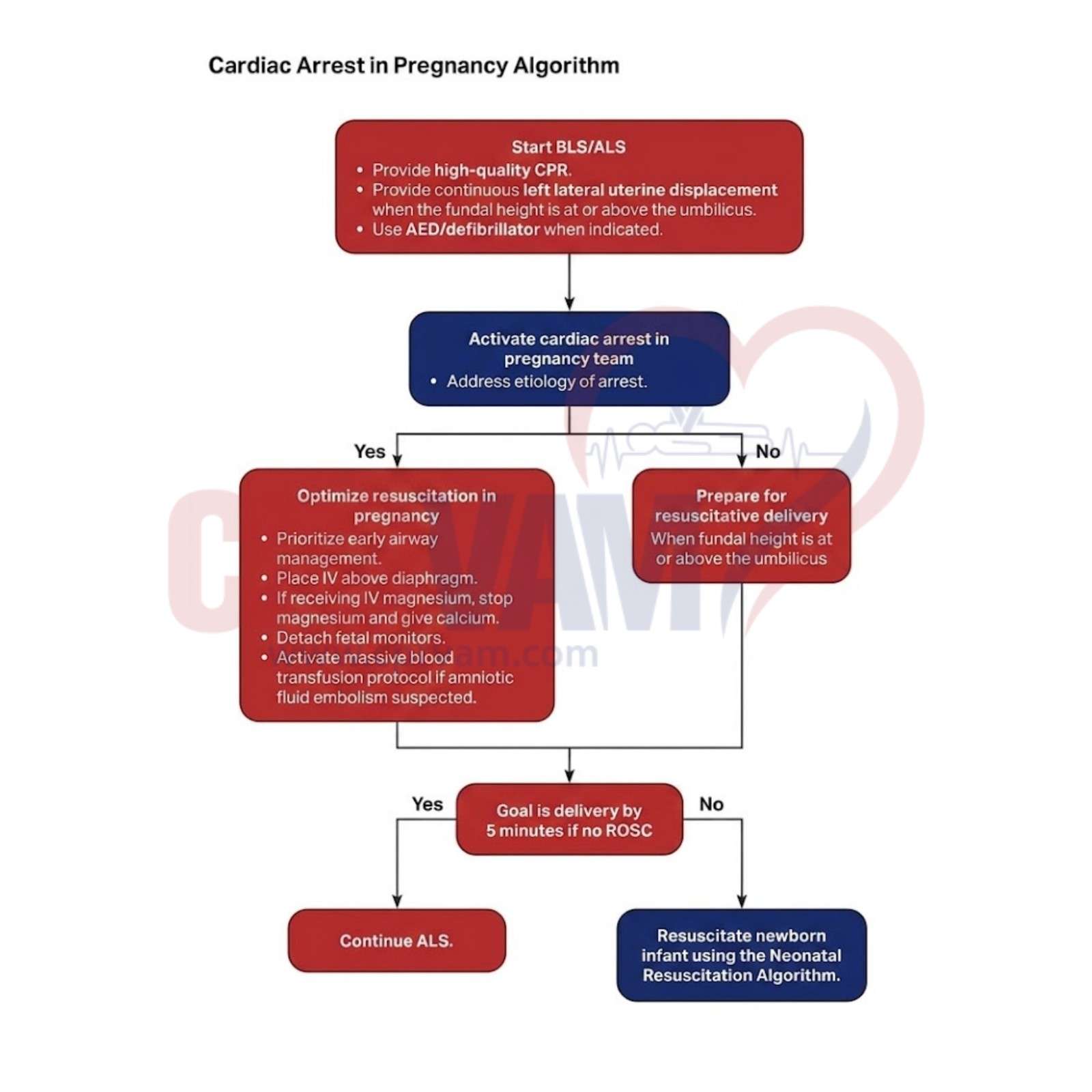
Cardiac arrest in pregnancy algorithm diagram

The Cardiac Arrest in Pregnancy Algorithm guides rapid, coordinated resuscitation, ensuring modified CPR, airway management, timely delivery decisions, and multidisciplinary teamwork to improve survival outcomes for both mother and fetus.

Importance of the Cardiac Arrest in Pregnancy Algorithm:

  1. Correction of Hemodynamic Obstruction
    The algorithm recommends manual left uterine displacement to relieve aortocaval compression and restore effective blood flow during CPR in pregnancy.

  2. Time-Critical Surgical Intervention (5-Minute Rule)
    It guides perimortem cesarean delivery if ROSC is not achieved within minutes to improve maternal circulation and fetal survival.

  3. Anatomical Modification of Advanced Life Support
    It emphasizes IV/IO access above the diaphragm to ensure medications reach central circulation effectively despite uterine compression.

  4. Specialized Airway and Oxygenation Strategy
    The algorithm calls for early airway management with 100% oxygen due to rapid desaturation and increased aspiration risk in pregnancy.

  5. Multi-Specialty Resource Mobilization
    It ensures rapid activation of a multidisciplinary team to coordinate simultaneous maternal resuscitation and neonatal preparedness.
The Cardiac Arrest in Pregnancy Algorithm provides a clear, stepwise in-hospital protocol for managing maternal cardiac arrest, ensuring rapid resuscitation, airway support, timely intervention, and coordinated multidisciplinary care to optimize outcomes for mother and baby.

Here are the comprehensive steps of the Cardiac Arrest in Pregnancy Algorithm:

1. Initiate Immediate BLS and ALS

Immediate resuscitation is the priority in maternal cardiac arrest. High-quality CPR maintains circulation, while defibrillation is used when indicated. Left uterine displacement improves venous return and enhances CPR effectiveness in pregnant patients.

Core Actions:

  • Start high-quality CPR immediately
  • Maintain 100-120 compressions/min with full recoil
  • Use an AED/defibrillator when needed
  • Apply left uterine displacement if fundus ≥ umbilicus
  • Avoid interruptions in compressions

2. Activate Maternal Cardiac Arrest Team

Early activation of a multidisciplinary team ensures coordinated response and faster decision-making. Clear role assignment improves efficiency while the team simultaneously identifies reversible causes and determines the appropriate resuscitation pathway.

Essential Points:

  • Activate the obstetric emergency response team
  • Include obstetric, anesthesia, and neonatal staff
  • Assign leadership and team roles
  • Identify the underlying cause of the arrest
  • Determine pregnancy vs delivery pathway

3. Optimize Resuscitation in Pregnancy

Pregnancy-specific adjustments improve maternal resuscitation outcomes. Airway management, vascular access above the diaphragm, and correction of medication-related complications are critical to stabilize the patient and prevent further deterioration.

Clinical Priorities:

  • Prioritize early advanced airway management
  • Establish IV/IO access above the diaphragm
  • Stop magnesium infusion if running
  • Give calcium if magnesium toxicity is suspected
  • Activate massive transfusion protocol if needed

4. Prepare for Resuscitative Delivery (5-Minute Goal)

If ROSC is not achieved, emergency delivery should be prepared promptly. The goal is rapid maternal stabilization through improved venous return and circulation, with strict time targets to maximize survival outcomes.

Critical Steps:

  • Assess fundal height (≥ umbilicus important)
  • Prepare for emergency resuscitative delivery
  • Target delivery within 5 minutes
  • Coordinate surgical and neonatal teams
  • Support maternal hemodynamics

5. Continue Advanced Life Support

Ongoing resuscitation focuses on maintaining circulation and correcting reversible causes. High-quality CPR must continue without interruption while defibrillation and medications are administered according to ACLS protocols.

Ongoing Management:

  • Continue uninterrupted high-quality CPR
  • Deliver shocks when indicated
  • Administer ACLS medications appropriately
  • Identify and treat reversible causes
  • Minimize pauses in compressions

6. Perform Resuscitative Delivery

When no ROSC is achieved within the critical timeframe, resuscitative delivery is performed. This intervention improves maternal circulation and can significantly enhance both maternal and fetal survival in cardiac arrest.

Immediate Actions:

  • Perform an emergency perimortem cesarean delivery
  • Start by 4 minutes if no ROSC
  • Complete by 5 minutes when possible
  • Improve maternal circulation rapidly
  • Maximize fetal survival chances

7. Initiate Neonatal Resuscitation

After delivery, the newborn requires immediate stabilization using neonatal resuscitation protocols. Rapid intervention, airway support, and thermal management are essential for improving neonatal outcomes.

Neonatal Focus:

  • Follow the Neonatal Resuscitation Algorithm
  • Provide airway and ventilation support
  • Maintain warmth and prevent hypothermia
  • Assign a dedicated neonatal team
  • Begin resuscitation immediately

ACLS in pregnancy requires important adjustments because the mother’s body changes significantly during pregnancy. These changes can affect circulation, breathing, and drug response, so specific modifications are needed to improve survival for both mother and baby during cardiac arrest.

Here are the key modifications to standard ACLS in pregnancy as follows:

1. Manual Left Uterine Displacement (LUD)

Manual left uterine displacement is used to relieve pressure from the pregnant uterus on major blood vessels like the inferior vena cava and aorta. This improves blood flow back to the heart during CPR and makes chest compressions more effective in maintaining circulation.

2. Higher Hand Placement for Chest Compressions

During pregnancy, internal organs are shifted upward, so chest compressions are performed slightly higher on the sternum than usual. This adjustment ensures better heart compression, improves blood circulation during CPR, and increases the effectiveness of resuscitation efforts in pregnant patients.

3. Early Airway Management

Pregnant patients are at higher risk of airway swelling, difficult intubation, and rapid oxygen desaturation. Early airway management is essential to maintain oxygen supply, reduce aspiration risk, and ensure proper ventilation during resuscitation, ideally performed by the most experienced provider available.

4. Careful Use of Medications

Some ACLS medications may have effects on the fetus, so they must be used with caution during pregnancy. However, the priority is always to stabilize and save the mother first, while following standard ACLS drug protocols to support effective resuscitation.

5. Perimortem Cesarean Delivery (PMCD)

If return of spontaneous circulation is not achieved within 4 minutes, perimortem cesarean delivery should be considered and initiated by 5 minutes. This helps relieve pressure on the mother’s blood vessels, improves circulation, and increases the chances of survival for both mother and baby.

6. Team Coordination and Clear Roles

Effective management of cardiac arrest in pregnancy requires a well-coordinated multidisciplinary team, including obstetric, anesthesia, neonatal, and resuscitation staff. Clear role assignment and strong communication ensure faster decision-making, reduce delays, and significantly improve outcomes for both patients.

Effective management of cardiac arrest in pregnancy requires immediate, structured, and pregnancy-adapted resuscitation to improve survival for both mother and baby. The ACLS algorithm emphasizes rapid CPR, uterine displacement, airway management, defibrillation, and timely decision-making in critical situations.

To build strong clinical readiness in emergencies like this, the CPR VAM Training Center provides expert-led training with experienced instructors. You can enroll in BLS, ACLS, and PALS courses to gain practical skills and confidence in life-saving care.

Pregnancy changes the position of organs and affects circulation, which can reduce the effectiveness of standard resuscitation techniques. Adjustments help maintain blood flow to both the mother and fetus during critical moments.

Shifting the uterus to the left reduces pressure on major blood vessels, improving blood return to the heart. This makes chest compressions more effective and supports better circulation during resuscitation.

Pregnant patients are at higher risk of oxygen desaturation and airway complications. Early airway support ensures adequate oxygen delivery and reduces the risk of complications during resuscitation.

If circulation is not restored within a few minutes, rapid delivery may be required to improve maternal blood flow and fetal survival chances. This decision is based on a time-sensitive clinical assessment.

Effective care requires coordination between multiple specialists, including obstetric, anesthesia, and emergency teams. Clear communication ensures faster decisions and improves survival outcomes for both mother and baby.

Advanced Cadiovascular Life Support