

CPRvam Students
25,000+ students successfully trained annually
Step-by-step treatment algorithms
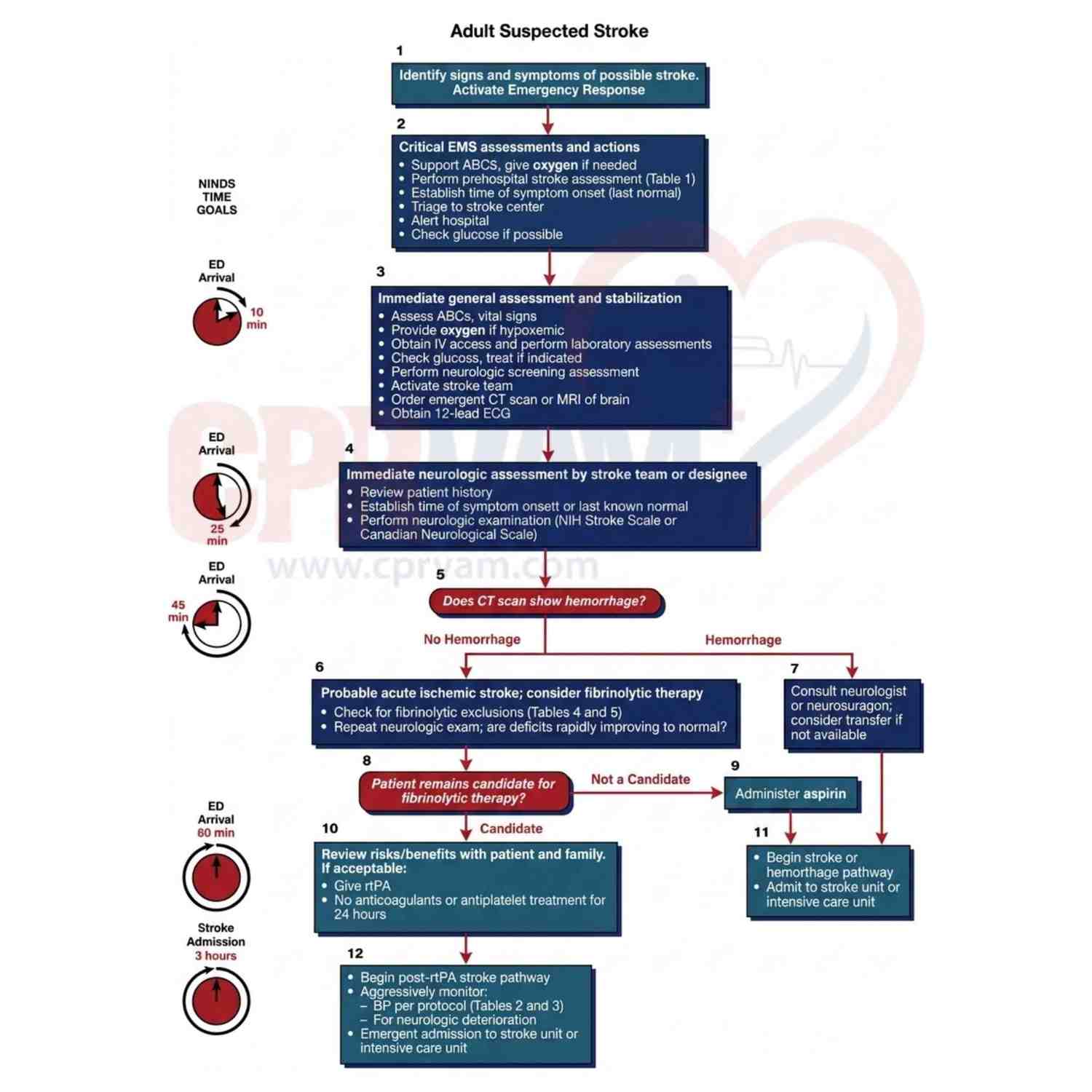
Adult suspected stroke algorithm

When a stroke is suspected, immediate action is essential. The Adult Suspected Stroke Algorithm by the American Heart Association provides a structured approach to quickly identify symptoms, reduce delays, support timely treatment, improve patient outcomes, and lower the risk of long-term disability and complications.

Here is the adult suspected stroke algorithm step-by-step guide:

Stroke is suspected with sudden neurological deficits like weakness, speech difficulty, or facial droop. BE FAST helps quick identification and immediate emergency activation to prevent irreversible brain damage and improve treatment outcomes.

Clinical Warning Indicators:

  • Sudden neurological symptoms always suggest a possible acute stroke
  • BE FAST improves early stroke recognition accuracy significantly
  • Facial droop, arm weakness, and speech issues are key signs
  • Vision and balance problems also indicate a possible stroke
  • Immediate action reduces brain damage and disability risk
  • Time-critical emergency requiring urgent medical response activation

Emergency services must be activated immediately after stroke suspicion. Early activation ensures hospital readiness, stroke team preparation, and imaging setup, and reduces delays that significantly affect neurological recovery and survival outcomes.

Rapid Response Essentials:

  • An immediate emergency call activates the stroke care pathway quickly
  • Hospitals prepare imaging and stroke teams in advance
  • Reduces critical delays in diagnosis and treatment initiation
  • Improves survival rates through faster medical intervention
  • Enables early thrombolysis and stroke management readiness
  • Ensures a coordinated prehospital and hospital communication system

EMS performs rapid stroke screening using CPSS, checks airway, breathing, circulation, glucose, oxygen levels, and determines the last known well time for safe transport and early hospital notification.

Field Assessment Priorities:

  • Uses validated stroke scales like the Cincinnati Prehospital Stroke Scale
  • Ensures airway, breathing, and circulation stability first
  • Blood glucose checked to rule out mimicking conditions
  • Oxygen support is provided if saturation is low
  • Determines the last known well time accurately
  • Pre-alerts the hospital for immediate stroke readiness

Patients must be transported directly to stroke-capable hospitals. Avoiding non-specialized centers ensures faster imaging, immediate expert evaluation, and timely access to thrombolysis or endovascular therapy for better outcomes.

Transport Optimization Factors:

  • Direct transport to the stroke center improves treatment speed
  • Avoid delays from non-specialized hospital transfers
  • Enables immediate CT scan and stroke evaluation
  • Increases eligibility for clot-busting therapy significantly
  • Improves survival and neurological recovery outcomes
  • EMS communicates arrival for hospital preparation

On arrival, airway, breathing, and circulation are stabilized immediately. Oxygen is given if needed, IV access is established, glucose is corrected, and stroke team activation continues simultaneously without delaying imaging.

Stabilization Priorities Checklist:

  • Stabilize airway, breathing, and circulation immediately
  • Oxygen is administered if saturation falls below normal levels
  • Intravenous access established for medications and fluids
  • Blood glucose is corrected if abnormal levels are detected
  • Stroke team activation continues simultaneously without delay
  • Preparation for urgent brain imaging begins immediately

Neurological evaluation using the NIH Stroke Scale determines severity and deficits. Symptom onset time is confirmed to guide treatment eligibility and decision-making for thrombolysis or advanced stroke intervention strategies.

Neuro Evaluation Focus Areas:

  • NIH Stroke Scale measures stroke severity accurately
  • Assesses speech, motor, vision, and consciousness levels
  • Confirms exact symptom onset time for treatment
  • Guides eligibility for thrombolytic therapy decisions
  • Helps determine stroke severity and prognosis
  • Supports urgent treatment planning and prioritization

A non-contrast CT scan is performed within 20 minutes. It quickly distinguishes ischemic from hemorrhagic stroke, guiding safe treatment decisions and preventing inappropriate thrombolytic administration in bleeding conditions.

Imaging Decision Criteria:

  • A non-contrast CT scan is the mandatory first imaging test
  • Must be completed within twenty minutes of arrival
  • Differentiates ischemic stroke from brain hemorrhage
  • Prevents unsafe thrombolytic drug administration
  • Guides immediate treatment pathway decisions
  • Critical step for accurate stroke management

Hemorrhagic stroke requires immediate specialist care. Thrombolytics are contraindicated. Management includes blood pressure control, intracranial pressure reduction, neurosurgical consultation, and ICU admission for intensive monitoring and stabilization.

Bleeding Stroke Management Steps:

  • Thrombolytic drugs are strictly avoided in hemorrhagic stroke
  • Immediate neurosurgical consultation is urgently required
  • Blood pressure control prevents further bleeding
  • Intracranial pressure management protects brain function
  • ICU admission is required for close monitoring
  • Surgical intervention may be necessary

If no hemorrhage is found, ischemic stroke treatment begins. Eligibility for thrombolysis is assessed based on time since onset, contraindications, and patient stability to restore blood flow quickly.

Reperfusion Decision Guidelines:

  • Confirm ischemic stroke before starting treatment
  • Time since symptom onset is a critical factor
  • Evaluate all contraindications carefully before therapy
  • Assess patient stability before intervention
  • Early treatment improves brain recovery outcomes
  • Rapid decision-making reduces disability risk

If the patient is not eligible for thrombolysis, aspirin is administered after excluding hemorrhage. It reduces platelet aggregation, prevents clot extension, and lowers the risk of recurrent ischemic stroke.

Antiplatelet Management Points:

  • Aspirin given after a hemorrhage is ruled out
  • Reduces further clot formation in brain vessels
  • Used when thrombolysis is not indicated
  • Helps prevent recurrent stroke events
  • Must ensure safe swallowing ability
  • Part of standard ischemic stroke care

Eligible patients receive alteplase within 60 minutes. It dissolves clots and restores blood flow. Careful monitoring is required due to the risk of intracranial hemorrhage and other bleeding complications.

Thrombolysis Administration Rules:

  • Alteplase is the standard thrombolytic for ischemic stroke
  • Administer within sixty minutes of door-to-needle target
  • Restores blood flow by dissolving the clot
  • Requires informed consent before administration
  • Monitor closely for bleeding complications
  • Avoid anticoagulants for twenty-four hours

Patients with large vessel occlusion undergo endovascular therapy. After treatment, they are admitted to stroke units or the ICU for monitoring, rehabilitation, complication prevention, and long-term neurological recovery planning.

Advanced Care Pathway Summary:

  • Endovascular therapy removes large vessel clots mechanically
  • Often combined with thrombolysis when appropriate
  • Rapid transfer to the cath lab is required
  • Intensive neurological monitoring after the procedure
  • Stroke unit supports recovery and rehabilitation
  • Early rehab improves long-term outcomes

The Adult Suspected Stroke Algorithm is a vital emergency guide that helps healthcare providers act quickly when stroke is suspected. It ensures early recognition, rapid response, and timely treatment to protect brain function, improve survival, and reduce long-term disability.

At the CPR VAM Training Center, you will learn these algorithms through practical, hands-on training based on AHA guidelines. The course builds confidence in emergency response, helping you apply stroke management steps effectively in real-life clinical situations when every second matters.
An ischemic stroke occurs when a blood clot blocks blood flow to the brain, reducing oxygen supply. A hemorrhagic stroke occurs when a blood vessel ruptures and causes bleeding in or around the brain, leading to brain injury.

Yes, this can happen in a condition called a transient ischemic attack (TIA), where symptoms appear briefly and then resolve. Even if symptoms disappear, it is a serious warning sign and requires immediate medical evaluation.

Blood pressure affects blood flow to the brain and must be carefully managed during stroke care. It is controlled differently depending on whether the stroke is ischemic or hemorrhagic.

A stroke can affect the muscles that control swallowing, making it unsafe for patients to eat or drink normally. A swallowing assessment helps prevent choking and aspiration pneumonia.

The “last known well” time helps doctors estimate when the stroke started. This is essential for deciding if the patient is eligible for time-sensitive treatments like thrombolysis.

Advanced Cadiovascular Life Support