
CPRvam Students
25,000+ students successfully trained annually
Step-by-step treatment algorithms
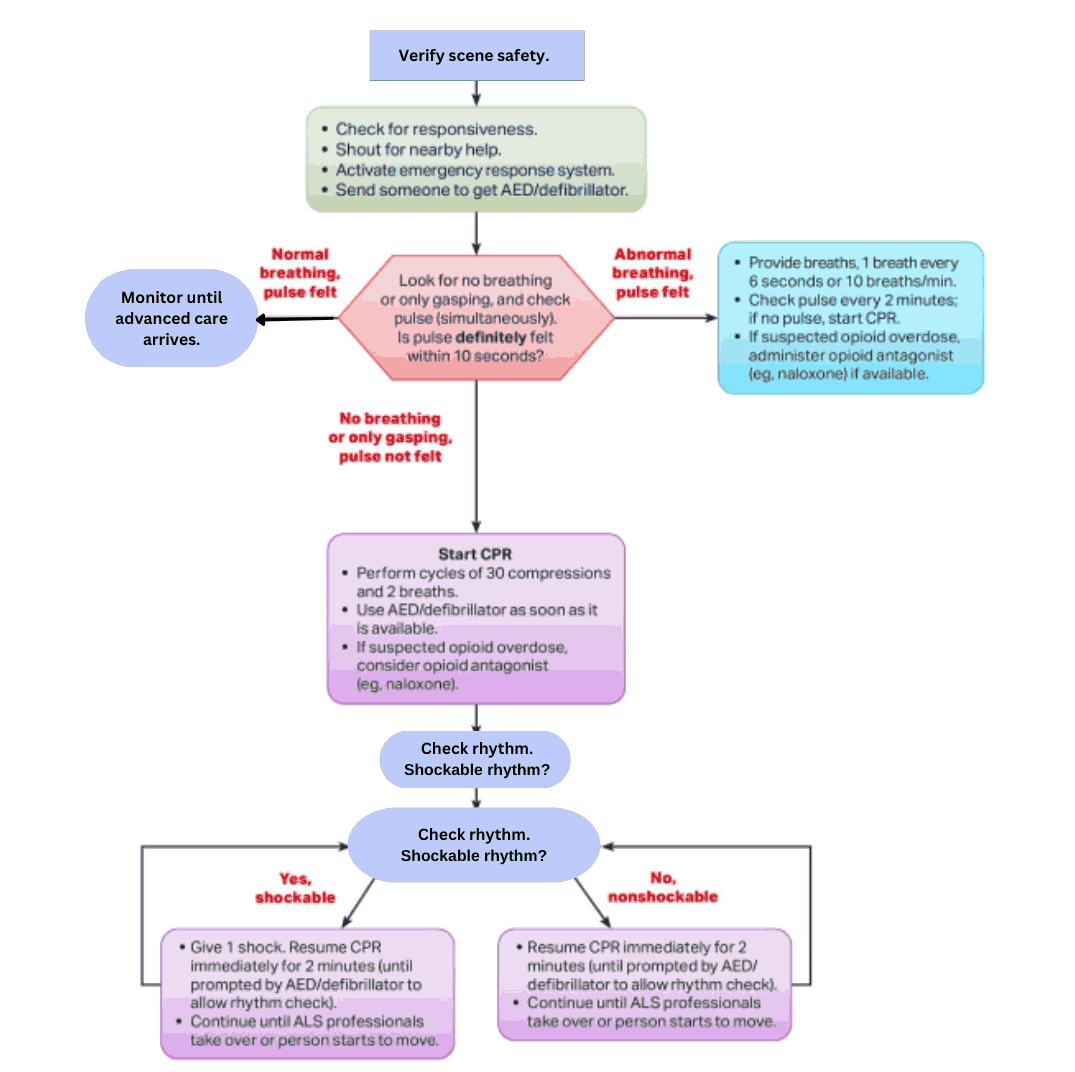
Flowchart of adult basic life support steps for emergencies

Ensure the environment is safe, check if the victim responds to touch and voice, and activate emergency services immediately if unresponsive to begin life-saving actions quickly.

  • Ensure the scene is safe for you and the victim
  • Tap shoulders and ask loudly for a response
  • Check if the victim reacts or moves
  • Call emergency services and request an AED

Quickly check breathing and carotid pulse together within 10 seconds to determine whether the victim needs CPR, rescue breaths, or monitoring until professional help arrives.

  • Look for normal chest movement
  • Listen for regular breathing, not gasping
  • Feel the carotid pulse using two fingers
  • Complete assessment within 10 seconds

Begin high-quality CPR with 30 compressions and 2 breaths, maintaining proper rate and depth, and continue cycles until an AED is available or professional medical help arrives.

  • Perform 30 chest compressions
  • Give 2 rescue breaths
  • Maintain proper rate and depth
  • Continue cycles until AED or help arrives

Once the AED is available, immediately turn it on and follow the voice and visual prompts. Proper use of the AED is critical in improving survival outcomes.

  • Expose the chest and attach AED pads as indicated (right upper chest and left lower side).
  • Ensure no one is touching the victim while the AED analyzes the heart rhythm.
  • The AED will determine whether a shock is needed.

If a Shock is Needed:

  • Ensure everyone is clear about the victim
  • Deliver the shock as prompted
  • Immediately resume CPR, starting with chest compressions for 2 minutes before the next rhythm check

If No Shock is Needed:

  • Resume CPR immediately for 2 minutes
  • Continue following AED prompts and reassess rhythm after each cycle
  • Do not delay CPR for AED setup to minimize interruptions at all times

5. Rhythm Evaluation

Assess the heart rhythm using an AED to determine if it is shockable or not, guiding whether to deliver a shock or continue CPR cycles effectively.

  • Turn on the AED and allow rhythm analysis
  • Ensure no one touches the victim
  • Identify shockable or non-shockable rhythm
  • Continue CPR for 2 minutes if no shock advised

6. Administer Shock and Resume High-Quality CPR

Deliver a shock if advised by the AED and immediately resume high-quality CPR, maintaining the correct rate, depth, and minimal interruptions until help arrives or recovery occurs.

  • Deliver shock immediately if advised
  • Ensure everyone is clear before shock
  • Resume CPR immediately after shock
  • Maintain proper rate, depth, and minimal interruptions

The Adult Basic Life Support (BLS) Algorithm is more than just a set of steps. It is a proven, systematic approach that can save lives in critical moments. Each phase of the algorithm is designed to support the chain of survival by ensuring safety, recognizing unresponsiveness, assessing breathing and pulse, providing immediate high-quality CPR, and using an AED without delay. When performed correctly and quickly, these actions significantly increase the chances of restoring normal heart function and preventing brain damage.

That’s why it is important to review your BLS skills regularly, keep up with the latest American Heart Association (AHA) updates, and practice the steps often so you’re ready when it counts. Learn life-saving skills with a certified course offered by CPR VAM is a practical way to stay prepared and confident in emergencies.
The Adult BLS Algorithm is a structured set of steps used to respond to cardiac arrest and other life-threatening emergencies. It guides rescuers in performing CPR, assessing breathing and pulse, and using an AED effectively.

CPR should begin immediately if the victim is unresponsive and has no normal breathing or pulse. Early CPR helps maintain blood flow to vital organs until advanced care arrives.

You should check breathing and carotid pulse at the same time within 10 seconds. Look for normal breathing, listen carefully, and feel for a pulse using two fingers on the neck.

Turn on the AED immediately and follow its voice prompts for pad placement and rhythm analysis. Resume CPR right after delivering a shock or if no shock is advised.

A shockable rhythm is a heart rhythm that can be corrected using a defibrillator shock. The AED automatically detects this and instructs you when to deliver a shock.