Yes, non-medical individuals can and should become CPR certified. CPR certification courses are designed for everyone, regardless of background or experience. Reputable organizations like the American Heart Association (AHA) offer widely recognized courses specifically created for everyday people who want to be prepared for emergencies. You do not need any medical knowledge to start.
In a CPR class, you’ll learn essential lifesaving skills such as performing chest compressions, using an AED, and helping someone who is choking. The training focuses on clear, practical actions that can help keep a person alive until professional help arrives.
This blog will guide you through everything you need to know about CPR certification as a non-medical individual. You’ll learn why CPR training is so important, how to choose the right class for your needs, and what to expect in a beginner-friendly course. We’ll also address common fears and misconceptions, so by the end, you’ll feel confident taking the first step toward certification and being ready to act in an emergency.
Why Should Non-Medical People Learn CPR?
When a person’s heart stops, their chance of survival drops with every passing minute. This is not only a medical fact; it is a reality that can happen anywhere, to anyone. According to the Centers for Disease Control and Prevention (CDC), about 350,000 cardiac arrests happen outside of hospitals each year. The most important factor for survival is having a bystander (an ordinary person nearby) who is ready to start CPR immediately before professional help arrives.
Learning CPR transforms you from a bystander into a potential lifesaver. Consider these real-life situations where non-medical people made a critical difference:
- A parent performing CPR on a choking child.
- An office worker using an AED on a co-worker who collapses.
- A coach assisting an athlete who goes into cardiac arrest during practice.
- A teacher responding to a student in distress.
Ultimately, the person you save is most likely to be someone you know and love. About 70% of cardiac arrests happen in homes. Getting certified is not just about helping strangers in public; it is about being prepared to protect your family, friends, and community in need. The emotional relief of knowing you can take action is invaluable instead of feeling helpless.
Which Training Is Best for Non-Medical People?
With different course names like “Heartsaver,” “First Aid/CPR/AED,” etc, choosing the right class can feel confusing. The key is to select a course designed specifically for the public, not for healthcare workers.
For non-medical individuals, the ideal and most common course is the “Heartsaver” course from the American Heart Association or an equivalent from other authorized providers. These courses are prepared from the ground up for laypeople, with clear, simple instructions and plenty of hands-on practice. They are regularly updated based on the latest AHA CPR and ECC Guidelines.
To make the choice clear, here is a comparison of the main course types:
Course Type | Designed For | What You Learn | Ideal For |
Heartsaver CPR/AED | Non-medical public | Adult/child/infant CPR, AED use, choking relief. | Parents, teachers, coaches, babysitters, and workplace safety. |
Heartsaver First Aid CPR/AED | Non-medical public | All of the above, plus first aid for bleeding, sprains, shock, etc. | Anyone wanting comprehensive emergency response skills. |
Basic Life Support (BLS) | Healthcare providers | 1-rescuer & team-based CPR for adults/children/infants, advanced airway techniques. | Nurses, doctors, EMTs, paramedics, nursing students. |
As the table shows, Heartsaver is your clear starting point. An authorized training center like CPR VAM offers these Non-Health Care Provider Classes, which bundle essential CPR, AED, and First Aid skills into one convenient course. This is the perfect choice for teachers, coaches, parents, and senior caregivers. For those in the fitness industry, CPR for gym instructors and personal trainers is the best option.
How Do Non-Medical People Get CPR Certification: Step-by-Step
The certification path is straightforward and designed to be accessible. From choosing a class to holding your certification card, the process typically involves four clear steps.
Step 1: Find and Register for the Right Class
Search for an authorized training center offering a “Heartsaver” or “Non-Health Care Provider” course from the American Heart Association. Providers like CPR VAM offer these specific classes with flexible scheduling. Simply choose your course and sign up for a session that fits your calendar.
Step 2: Complete the Learning Portion
After registering, you’ll get access to interactive online lessons. You complete these self-paced modules on your own time, learning the “why” behind CPR through videos and short quizzes. This prepares you perfectly for the hands-on session.
Step 3: Attend the In-Person Skills Session
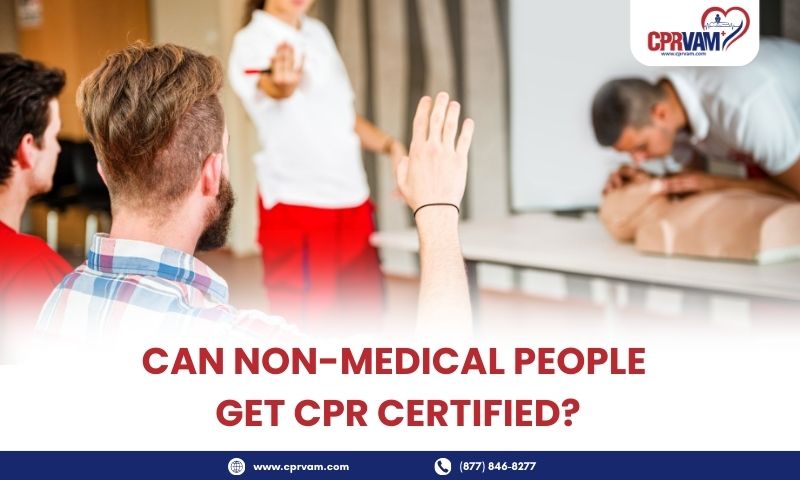
This is the practical, supportive core of your training. In a small group with a certified instructor, you’ll practice on manikins. You’ll physically perform chest compressions, use a training AED, and practice choking relief. The instructor provides immediate, helpful feedback to build your muscle memory and confidence.
Step 4: Pass the Skills Test and Get Certified
The “test” is simply showing your instructor you can perform the key skills competently. There is no scary written exam. Once you successfully demonstrate the techniques, you receive your official certification, often a digital AHA provider eCard emailed the same day. This certification is valid for two years with nationwide recognition.
What Happens in CPR Classes for Non-Medical People?
Walking into your first CPR class, you might not know what to expect. Rest assured, the environment is welcoming and focused on building your skills through practice, not complex theory. A typical Heartsaver class for non-medical people breaks down into a few key segments, all centered on hands-on learning.
The class usually starts with a review of key concepts from the online portion, followed immediately by practical application. The instructor will demonstrate a skill on a manikin, and then you will get to practice it yourself. You will spend most of your time on the floor, working with your own practice manikin.
The core skills you will practice repeatedly are:
- Scene Safety and Assessment
Learning to quickly ensure the area is safe for you and the victim. - Activating Emergency Services
Practicing how to make a clear, effective 911 call. You’ll learn what information to give first, like the exact location and the victim’s condition, and how to follow the dispatcher’s guidance. - High-Quality Chest Compressions
This is the main skill. You will practice pushing hard and fast (at least 2 inches deep and 100-120 times per minute) on adult, child, and infant manikins. Feedback manikins often light up to show if your compressions are effective. - AED Use
You will practice with a training AED, following its clear voice and visual prompts to deliver a simulated shock. - Relieving Choking
You’ll learn and practice the correct techniques to help someone who can’t breathe. For a deeper understanding of the physiology, you can refer to resources like the NCBI Bookshelf on CPR.
Instructors are there to coach you, not to intimidate you. They understand everyone is a beginner and will patiently correct your hand placement or technique. The atmosphere is collaborative, often with students practicing in pairs or small groups. By the end of the 2-4-hour session, the motions of CPR will start to feel more natural, and your initial anxiety will be replaced by a solid sense of “I can do this.”
How to Clarify Common CPR Myths for Beginners?
Many people hesitate to get certified due to common fears and misconceptions. Let’s clear up the top three myths that stop non-medical people from taking a CPR class.
Myth 1: You need a medical background to enroll in a CPR certification class.
Reality: This is false. Certification courses like the AHA’s “Heartsaver” are explicitly designed for the general public, non-medical individuals, and workplace responders. No prior knowledge is required.
Myth 2: The certification class will be too advanced, technical, or fast-paced for a beginner to understand.
Reality: Instructors are trained to teach people with zero experience. The curriculum uses plain language, focuses on hands-on practice, and moves at a pace set for new learners.
Myth 3: The certification test will be a difficult written exam on complex medical topics.
Reality: For non-medical provider courses, the “test” is typically a straightforward skills demonstration. You show the instructor you can perform chest compressions and use an AED on a manikin. There is no intimidating written test.
Myth 4: As a non-medical person, your CPR certification won’t be valid or recognized.
Reality: A certification card from a nationally recognized organization (like the AHA or Red Cross) is valid and accepted by employers, schools, and organizations nationwide, regardless of your profession.
Myth 5: You need to be physically strong, young, or extremely fit to pass the certification.
Reality: CPR is about technique and endurance, not brute strength. The course teaches proper body mechanics that allow most people to perform effective compressions. The skill session ensures you can demonstrate the technique correctly.
Myth 6: Getting certified as a non-medical person isn’t worthwhile because you’d be too afraid to act in a real emergency.
Reality: The primary goal of certification is to build the confidence to act. Repetitive, hands-on practice in a safe class environment directly reduces panic and gives you a clear mental checklist to follow, making you far more likely to help.
Myth 7: If you are certified and make an error while helping someone, you could face legal liability.
Reality: All 50 states have Good Samaritan Laws that protect lay rescuers who act in good faith during an emergency. Your certification demonstrates that you act as a trained responder, further supporting your legal protection.
Ready to Get Certified? Enroll with CPR VAM
You now know that CPR certification is not only possible for you, but it’s also straightforward and designed for beginners. You have the power to turn that knowledge into lifesaving action. Don’t wait for a crisis to reveal the need. Choose to be prepared now. By getting certified, you replace fear with confidence and become someone’s crucial chance for survival.
Ready to take the final step? Find and enroll in your beginner-friendly Heartsaver CPR certification class at CPR VAM today.
FAQs
1. Do I Need to Be a Certain Age to Get CPR Certified as a Non-Medical Person?
No, there is no official minimum age requirement for learning CPR from organizations like the American Heart Association. However, a student typically needs the physical strength to perform effective chest compressions on an adult manikin and the maturity to follow the course material. Many providers suggest that participants be at least 12-13 years old, but classes are available for younger children that focus on awareness and calling for help.
2. How Long Does the Certification Last, and How Do I Renew It as a Non-Medical Person?
A standard CPR/AED certification for non-medical providers is valid for two years. The renewal process is simple and mirrors the initial certification. You will take a shorter “renewal” or “update” course, which reviews the core skills and any updated guidelines. This ensures your knowledge and muscle memory stay current and effective.
3. Is There a Difference Between a "Certificate of Completion" and An Official "Certification Card"?
Yes, there is a key difference. An official certification card (or eCard) is issued by an authorized training center (like an AHA or Red Cross) after you successfully pass both the knowledge and skills evaluations. It has your name, a unique ID, and an expiration date. A “certificate of completion” may be given after an informal workshop that does not include a formal skills test and may not be widely recognized by employers or institutions.
4. Can my Employer Require Me to Get CPR Certified Even If I Don't Have a Medical Background?
Absolutely. Many employers in fields like education, fitness, construction, and childcare require CPR/AED certification for safety and liability reasons. This is a common reason non-medical people seek certification. Employers often provide or pay for this job-related training, recognizing it as a valuable workplace skill.
5. If I Take a class, Will I have to Perform rescue Breaths ("Mouth-To-Mouth")?
For non-medical public courses, the primary focus is on CPR without rescue breaths, continuous chest compressions without breaths. This is the method strongly promoted for untrained or lay responders. The full course with rescue breaths is also taught, but you can discuss your comfort level with the instructor. The most critical action for a sudden cardiac arrest is to start chest compressions immediately.