

- 2026
CPR VAM • All Rights Reserved • Developed by Splendour Group

Understanding How to Recognize and Manage Pediatric Emergencies
This guide expands on the PALS infographic by explaining the purpose behind each assessment, algorithm, and intervention. Whether you’re preparing for your certification exam or refreshing your knowledge, this guide will help you understand the clinical reasoning behind pediatric emergency care.
Pediatric Advanced Life Support (PALS) is an advanced resuscitation program designed for healthcare professionals who care for critically ill or injured infants and children. It provides a structured approach to assessing, stabilizing, and treating pediatric emergencies using evidence-based guidelines.
Unlike Basic Life Support (BLS), which focuses primarily on CPR and AED use, PALS emphasizes early recognition of clinical deterioration so treatment can begin before cardiac arrest occurs.
PALS addresses four major pediatric emergencies:
In addition to medical knowledge, PALS teaches providers how to communicate effectively and function as part of a coordinated resuscitation team.
High-quality CPR remains the foundation of pediatric resuscitation and significantly improves survival. Effective chest compressions maintain blood flow to the brain and heart until normal circulation can be restored.
The American Heart Association recommends:
Quality CPR also requires:
Delivering consistent, high-quality CPR is one of the most important factors influencing survival from pediatric cardiac arrest.
PALS algorithms provide healthcare professionals with standardized pathways for managing pediatric emergencies. Following these algorithms helps providers make rapid, evidence-based decisions during high-stress situations.
The primary algorithms include:
Guides providers through CPR, rhythm identification, defibrillation, medication administration, and post-resuscitation care.
Used when a child has a slow heart rate with poor perfusion despite adequate oxygenation and ventilation.
Helps differentiate stable from unstable tachycardia and guides treatment using vagal maneuvers, medications, or synchronized cardioversion.
Focuses on early recognition of sepsis, rapid fluid administration, antibiotic therapy, vasoactive medications, and ongoing reassessment.
Provides guidance for managing patients after return of spontaneous circulation (ROSC), including oxygenation, ventilation, blood pressure support, temperature management, and neurological monitoring.
Successful pediatric resuscitation is based on several core principles that guide every intervention.
Most pediatric cardiac arrests are preventable if respiratory failure or shock is recognized and treated early.
Provide effective chest compressions with proper rate, depth, and minimal interruptions.
Clear communication reduces errors and improves coordination during emergencies.
Use medications, airway management, defibrillation, and fluid therapy based on the patient’s condition.
Patient conditions can change rapidly. Reassess airway, breathing, circulation, and response to treatment throughout the resuscitation.
The ABCDE assessment helps healthcare providers rapidly identify and manage life-threatening problems while treatment is occurring.
Ensure the airway is open and free from obstruction.
Interventions include:
Assess:
Evaluate:
Perform a rapid neurological assessment using:
Completely expose the patient to identify injuries or rashes while preventing hypothermia.
The Pediatric Assessment Triangle (PAT) allows providers to evaluate a child’s condition within 30 to 60 seconds without physical contact.
Assess:
Abnormal findings may indicate poor brain perfusion or respiratory compromise.
Observe for:
These signs indicate increasing respiratory effort.
Look for:
Abnormal skin findings may suggest poor perfusion or shock.
The Pediatric Assessment Triangle helps determine whether the child is experiencing respiratory distress, respiratory failure, shock, or cardiopulmonary failure before initiating more detailed assessments.
Children require different treatment approaches based on their age and size.
Patients younger than one year require specialized CPR techniques, equipment sizes, and medication dosages.
Children between one year and puberty require age-appropriate airway equipment, defibrillation energy levels, and weight-based medications.
Always remember:
Once life-threatening problems have been addressed, perform a focused history and physical examination to determine the underlying cause of the emergency.
Gather information using the SAMPLE mnemonic:
Assess:
The secondary assessment helps guide further treatment and identify contributing conditions.
Continuous monitoring allows providers to evaluate treatment effectiveness and detect changes in the patient’s condition.
Common diagnostic tools include:
Detects cardiac rhythm abnormalities and guides treatment.
Monitor oxygenation and ventilation.
Evaluate glucose, electrolytes, blood gases, infection markers, and other laboratory values.
Chest X-rays, ultrasound, or CT imaging may identify respiratory disease, trauma, or internal injuries.
Shock occurs when tissues receive inadequate oxygen and blood flow.
The four major types include:
Usually caused by dehydration, hemorrhage, or burns.
Includes septic, anaphylactic, and neurogenic shock.
Results from impaired heart function such as myocarditis or congenital heart disease.
Occurs when blood flow is physically obstructed by conditions such as cardiac tamponade or tension pneumothorax.
Treatment priorities include:
Prompt intervention before hypotension develops greatly improves patient outcomes.
Effective teamwork is essential during pediatric resuscitation.
Strong team dynamics improve CPR quality, reduce delays, and enhance patient safety.
Key components include:
The team leader assigns responsibilities, monitors performance, and coordinates care.
Every instruction should be acknowledged and confirmed to reduce misunderstandings.
Each provider should have a clearly defined responsibility, such as:
Team members should remain aware of changes in patient status and anticipate upcoming interventions.
Communicate patient updates and important findings with the entire team.
After every resuscitation, review what went well and identify opportunities for improvement.
Immediate recognition and intervention are essential during pediatric cardiac arrest.
The basic sequence includes:
Early CPR combined with rapid defibrillation when indicated provides the best chance of survival.
Before your certification exam, review these essential concepts:
Understanding these concepts—not simply memorizing algorithms—will help you respond confidently during pediatric emergencies and perform successfully on the PALS certification exam.
This study guide is intended for healthcare professionals, nursing and medical students, paramedics, respiratory therapists, and anyone preparing for an AHA PALS certification or renewal course. It also serves as a valuable refresher for experienced providers who want to review pediatric emergency care principles.
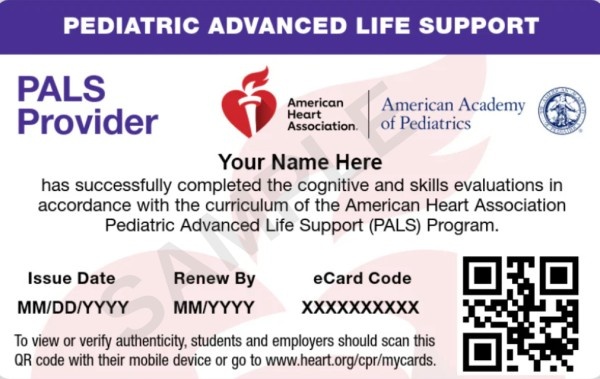
No. This guide is designed to reinforce key PALS concepts and help you prepare for your course or certification exam. To earn an official American Heart Association PALS Provider Card, you must successfully complete an authorized PALS course and required skills evaluation.
Pay close attention to the Pediatric Assessment Triangle (PAT), the ABCDE assessment, high-quality pediatric CPR, respiratory emergencies, shock recognition, cardiac arrest algorithms, bradycardia and tachycardia management, weight-based medication principles, and effective team communication.
Read each section carefully to understand the clinical reasoning behind the PALS algorithms rather than simply memorizing steps. Pair this guide with the downloadable infographic, practice scenarios, and the official HeartCode® learning materials to strengthen your understanding.
Many pediatric emergencies begin with respiratory distress or shock before progressing to cardiac arrest. Identifying these warning signs early allows healthcare providers to intervene sooner, improving patient outcomes and reducing the risk of cardiac arrest.