
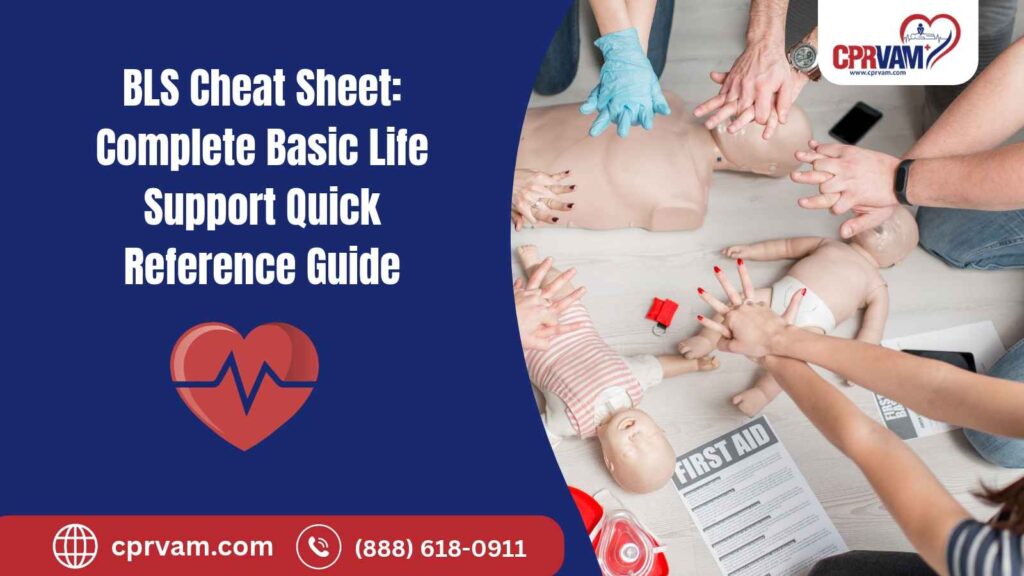
Basic Life Support (BLS) includes essential emergency skills for recognizing cardiac arrest, performing cardiopulmonary resuscitation (CPR), supporting breathing, using an automated external defibrillator (AED), and managing choking. This BLS cheat sheet follows American Heart Association (AHA) guidance to help healthcare professionals, nursing students, EMTs, and first responders review key life-saving procedures.
This quick reference covers adult CPR, pediatric and infant resuscitation, rescue breathing, AED use, and high-quality CPR principles. It also supports BLS certification exam preparation and clinical learning. However, it does not replace hands-on training or current official AHA guidelines. In an emergency, contact local emergency services, follow dispatcher instructions, and use the latest applicable resuscitation recommendations.
This blog provides a practical overview of essential BLS procedures, helping readers understand key techniques and review important concepts efficiently.
What Is a BLS Cheat Sheet?
A BLS cheat sheet is a quick reference guide that summarizes essential Basic Life Support procedures for medical emergencies. Based on current American Heart Association (AHA) guidance, it helps healthcare professionals, nursing students, EMTs, and first responders review CPR techniques, rescue breathing, AED use, and choking relief.
A typical BLS reference guide covers:
The steps for recognizing cardiac arrest and initiating a response.
CPR compression rates and depths for adults, children, and infants.
Compression-to-ventilation ratios for single and multiple rescuers.
Rescue breathing when a pulse is present.
AED operation and safety precautions during shock delivery.
Choking relief for conscious and unresponsive individuals.
High-quality CPR principles and common mistakes to avoid.
Key topics for BLS certification exam preparation.
A BLS cheat sheet makes important information easier to review and remember during training or study. However, it does not replace hands-on practice, instructor feedback, official AHA guidelines, or required certification training. Always follow the latest recommendations and applicable emergency protocols when providing care.
BLS Cheat Sheet at a Glance
The following table summarizes key Basic Life Support (BLS) CPR parameters based on American Heart Association (AHA) guidelines. Use it to review compression rates, depths, CPR ratios, rescue breathing, and hand placement for adults, children, and infants. Always consult the latest official guidelines for complete instructions.
BLS Guideline | Adult | Child (1 year to puberty) | Infant (under 1 year) |
Chest Compression Rate | 100-120 compressions per minute | 100-120 compressions per minute | 100-120 compressions per minute |
Compression Depth | At least 2 inches (5 cm), avoiding depths greater than 2.4 inches (6 cm) | At least one-third of the chest’s front-to-back diameter, approximately 2 inches (5 cm) | At least one-third of the chest’s front-to-back diameter, approximately 1.5 inches (4 cm) |
CPR Ratio: One Rescuer | 30 compressions to 2 breaths (30:2) | 30 compressions to 2 breaths (30:2) | 30 compressions to 2 breaths (30:2) |
CPR Ratio: Two Rescuers | 30 compressions to 2 breaths (30:2) | 15 compressions to 2 breaths (15:2) | 15 compressions to 2 breaths (15:2) |
Pulse-Check Duration for Healthcare Professionals | No more than 10 seconds | No more than 10 seconds | No more than 10 seconds |
Rescue Breathing When a Pulse is Present | 1 breath every 6 seconds (10 breaths per minute) | 1 breath every 2–3 seconds (20-30 breaths per minute) | 1 breath every 2–3 seconds (20-30 breaths per minute) |
Chest Compression Technique | Use two hands, one on top of the other, on the center of the chest | Use one or two hands, depending on the child’s size, on the lower half of the breastbone | Use the infant compression technique specified in current AHA guidance, such as the two-thumb encircling technique when appropriate |
Age Categories: Adults have reached puberty; children are approximately 1 year old to puberty; and infants are younger than 1 year, excluding newborn resuscitation immediately after birth, which follows a separate neonatal resuscitation algorithm.
Reference: American Heart Association (AHA) adult Basic Life Support (BLS) and AHA/American Academy of Pediatrics (AAP) pediatric BLS guidance. Verify clinical details against the latest official recommendations before using this table in training or patient care.
Understanding C-A-B: The Foundation of CPR
The C-A-B sequence stands for Compressions, Airway, and Breathing. It provides a simple way to remember the main steps of CPR during cardiac arrest. American Heart Association (AHA) guidelines emphasize starting high-quality chest compressions promptly, managing the airway, providing breaths when indicated, and using an AED as soon as possible.
C — Compressions
Chest compressions help keep blood flowing to the brain and other vital organs when the heart cannot pump effectively. To perform high-quality CPR:
Place the person on a firm, flat surface when possible.
Position your hands correctly based on the person’s age.
Maintain the recommended compression rate and depth.
Allow the chest to return to its normal position after each compression.
Keep interruptions as short as possible.
A — Airway
Once compressions are underway, when indicated, open the airway using the head-tilt/chin-lift technique when appropriate. If a head or neck injury is suspected, trained healthcare professionals should follow their training and applicable protocols to manage the airway safely without unnecessarily delaying lifesaving care.
B — Breathing
Give rescue breaths when indicated and when you are trained and able to provide them. Each breath should last about one second and make the chest visibly rise. Avoid giving breaths too quickly or forcefully, as excessive ventilation can reduce the effectiveness of CPR.
Remember: High-quality chest compressions, appropriate rescue breathing, early AED use, and prompt activation of emergency services are essential parts of BLS. Effective ventilation is especially important in pediatric emergencies because breathing problems often contribute to cardiac arrest in children. Always follow current AHA recommendations, local emergency protocols, and your level of training.
The BLS Algorithm: Step-by-Step Guide
The Basic Life Support (BLS) algorithm provides a structured approach to recognizing cardiac arrest and responding quickly. According to American Heart Association (AHA) guidance, the appropriate steps depend on the patient’s age, breathing, pulse, available equipment, and number of rescuers. The following sequence offers a practical overview for learning and reviewing essential BLS procedures.
Step 1: Check Scene Safety
Before approaching the patient, check for immediate dangers such as traffic, fire, electrical hazards, chemicals, or other unsafe conditions. Do not enter an unsafe environment. Use appropriate personal protective equipment when available, and make sure the scene is safe enough to assist.
Step 2: Check Responsiveness
Check whether the person responds by tapping their shoulders, when appropriate, and asking loudly, “Are you okay?” For an infant, gently tap the foot and look for a response. Never shake an infant or young child.
If the person is unresponsive, call for help and activate the emergency response system. Acting promptly helps ensure that emergency assistance and resuscitation equipment can be obtained without unnecessary delay.
Step 3: Activate Emergency Services and Get an AED
Call your local emergency number or direct a specific person to call. If possible, use speakerphone so you can follow the emergency dispatcher’s instructions while assisting the patient.
Ask someone to bring an automated external defibrillator (AED) and emergency equipment. If you are alone, follow dispatcher instructions and the applicable BLS algorithm for emergency activation, CPR, and AED retrieval.
Step 4: Assess Breathing and Pulse When Appropriate
Check whether the person is breathing normally. Occasional gasps or abnormal gasping are not normal breathing and may indicate cardiac arrest.
Healthcare professionals should check breathing and pulse simultaneously within 10 seconds. Use the carotid pulse for adults and children and the brachial pulse for infants. Lay rescuers should not delay CPR for a pulse check. Begin CPR if the person is unresponsive and not breathing normally.
Step 5: Begin CPR When Indicated
For healthcare professionals, begin CPR if the patient is unresponsive, has absent or abnormal breathing, and has no definite pulse within 10 seconds. Start with chest compressions and use the appropriate compression-to-ventilation ratio based on the patient’s age and the number of rescuers.
Step 6: Use the AED as Soon as Possible
When the AED arrives, turn it on and follow its voice prompts. Attach the pads as instructed and make sure everyone stands clear while the device analyzes the heart rhythm and delivers a shock, if advised.
After a shock, or when the AED advises that no shock is needed, resume CPR immediately as directed by the device. Continue following its prompts and minimize interruptions to chest compressions.
Step 7: Continue Resuscitation
Continue CPR and follow AED instructions until the person shows signs of life, trained emergency responders take over, the scene becomes unsafe, or you cannot physically continue. If the person begins breathing normally, reassess their condition and follow dispatcher instructions.
Key takeaway: The BLS algorithm helps rescuers respond systematically by checking scene safety, recognizing possible cardiac arrest, activating emergency services, starting CPR when indicated, and using an AED promptly. For clinical decisions and hands-on practice, follow the latest official AHA BLS algorithms and applicable local emergency protocols.
Adult BLS Cheat Sheet
Adult Basic Life Support (BLS) focuses on recognizing cardiac arrest, starting high-quality cardiopulmonary resuscitation (CPR), and using an automated external defibrillator (AED) as soon as possible. The following steps summarize key adult CPR procedures based on American Heart Association (AHA) guidance.
1. Adult CPR Steps
Check Scene Safety: Make sure the area is safe before approaching the person.
Check Responsiveness: Tap the person’s shoulders, ask loudly if they are okay, and call for help if they do not respond.
Activate Emergency Services: Call your local emergency number and ask someone to bring an AED.
Check Breathing and Pulse: Healthcare professionals should assess both simultaneously for no more than 10 seconds.
Start CPR When Indicated: If the person is unresponsive, is not breathing normally, and has no definite pulse, begin CPR immediately.
Perform Chest Compressions and Rescue Breaths: For conventional adult CPR without an advanced airway, use 30 compressions followed by 2 breaths.
Administer the AED: Turn it on, attach the pads, and follow the device’s instructions as soon as it arrives.
2. Adult Chest Compression Technique
High-quality chest compressions help maintain blood flow to the brain and other vital organs during cardiac arrest. Follow these key steps:
Place the heel of one hand in the center of the chest, on the lower half of the breastbone (sternum).
Place your other hand on top and interlock your fingers.
Keep your shoulders directly above your hands and your elbows straight.
Compress at a rate of 100-120 compressions per minute.
Compress the chest at least 2 inches (5 cm), avoiding depths greater than 2.4 inches (6 cm).
Allow the chest to return fully to its normal position after every compression.
Minimize interruptions to chest compressions.
If another trained rescuer is available, switch compressors about every two minutes, preferably during a planned pause.
3. Adult Compression-to-Breath Ratio
For conventional adult CPR without an advanced airway, use 30 chest compressions followed by 2 rescue breaths (30:2), whether one or two rescuers are providing CPR.
If you are untrained or unable to give rescue breaths, compression-only CPR is preferable to taking no action while waiting for emergency assistance. Follow emergency dispatcher instructions whenever possible.
4. Adult Rescue Breathing
If a healthcare professional confirms that an adult has a pulse but is not breathing normally, provide one breath every 6 seconds, equivalent to approximately 10 breaths per minute.
Each breath should last about one second and produce visible chest rise. Avoid excessive ventilation, and reassess the pulse approximately every two minutes. If the pulse becomes absent or you cannot confidently detect it within 10 seconds, follow the current adult BLS algorithm and begin CPR when indicated.
Clinical Reminder: This BLS cheat sheet is a study aid, not a substitute for practical training. Always follow the latest official AHA recommendations, applicable local emergency protocols, and emergency dispatcher instructions.
In pediatric emergencies, a heart rate below 60 beats per minute with signs of poor perfusion despite adequate oxygenation and ventilation may also indicate the need for CPR. Trained healthcare professionals should follow the current pediatric BLS algorithm to determine the appropriate response.
Pediatric BLS Cheat Sheet
Pediatric Basic Life Support (BLS) applies to children from 1 year of age until puberty. Because breathing problems often contribute to cardiac arrest in children, high-quality chest compressions and effective ventilation are essential. The following pediatric CPR reference summarizes key procedures based on American Heart Association (AHA) guidance.
1. Pediatric CPR Steps
Check Scene Safety: Make sure the area is safe before approaching the child.
Check Responsiveness: Gently tap the child’s shoulders and call out to check for a response.
Activate Emergency Services: Call for help and ask someone to bring an automated external defibrillator (AED).
Assess Breathing and Pulse: Healthcare professionals should check both simultaneously for no more than 10 seconds.
Begin CPR: If the child is unresponsive, is not breathing normally, and has no definite pulse, start CPR.
Use the Correct CPR Technique: Follow the recommended compression depth, rate, and compression-to-breath ratio.
Apply the AED: Use it as soon as it is available and follow its instructions.
For a lone healthcare professional, the recommended sequence for activating emergency services and obtaining an AED may depend on the circumstances of the collapse. Follow the current pediatric BLS algorithm rather than relying on a memorized shortcut.
2. Pediatric Chest Compressions
Proper chest compressions help maintain blood flow to the brain and other vital organs during cardiac arrest. Follow these key steps:
Place one or two hands on the lower half of the breastbone (sternum), depending on the child’s size.
Maintain a rate of 100-120 compressions per minute.
Compress at least one-third of the chest’s front-to-back diameter, approximately 2 inches (5 cm).
Allow the chest to recoil fully after each compression.
Minimize interruptions to maintain circulation.
Provide rescue breaths that produce visible chest rise without excessive ventilation.
3. Pediatric Compression-to-Breath Ratio
The recommended CPR ratio depends on the number of rescuers providing conventional CPR without an advanced airway.
Number of Rescuers | Compression-to-Breath Ratio |
One Rescuer | 30 compressions to 2 breaths (30:2) |
Two or More Rescuers | 15 compressions to 2 breaths (15:2) |
When another trained rescuer arrives, coordinate your actions and follow the appropriate two-rescuer pediatric CPR technique.
Infant CPR Cheat Sheet
Infant Basic Life Support (BLS) applies to infants younger than 1 year, excluding newborn resuscitation immediately after birth, which follows a separate neonatal resuscitation algorithm. Infant CPR requires careful attention to compression depth, hand placement, and ventilation to support circulation and oxygen delivery.
3. Infant CPR Steps
Check Scene Safety: Make sure the environment is safe.
Check Responsiveness: Gently tap the infant’s foot and look for a response. Never shake an infant.
Call for Help: Activate emergency services and obtain an AED when available.
Assess Breathing and Pulse: Healthcare professionals should check breathing and the brachial pulse simultaneously for no more than 10 seconds.
Begin CPR When Indicated: If the infant is unresponsive, is not breathing normally, and has no definite pulse, start CPR.
Use the Correct Compression Technique: Follow the recommended infant compression depth and CPR ratio.
Use an AED: Apply it as soon as possible and follow its prompts, using pediatric settings or pads when available and appropriate.
2. Infant Chest Compression Technique
The 2025 AHA pediatric BLS guidance includes updated recommendations for infant chest compressions. Follow the technique taught in your current course and specified in the applicable official algorithm.
Two-Thumb Encircling-Hands Technique: Place both thumbs on the sternum while encircling the infant’s chest with your hands.
Heel-of-One-Hand Technique: Use the heel of one hand on the sternum, as appropriate under current guidance.
Compress at least one-third of the chest’s front-to-back diameter, approximately 1.5 inches (4 cm). Maintain a rate of 100-120 compressions per minute and allow full chest recoil after every compression.
Important: The traditional two-finger technique is not included among the recommended infant compression techniques in the updated AHA pediatric BLS guidance. Check the current official algorithm and your course materials for the technique required in practice.
3. Infant Compression-to-Breath Ratio
During conventional infant CPR without an advanced airway, use a compression-to-breath ratio of 30:2 for a single rescuer and 15:2 when two or more rescuers are present.
Deliver each breath gently over approximately one second, using only enough air to produce visible chest rise. Avoid excessive or forceful ventilation, as it can cause complications and interfere with effective resuscitation.
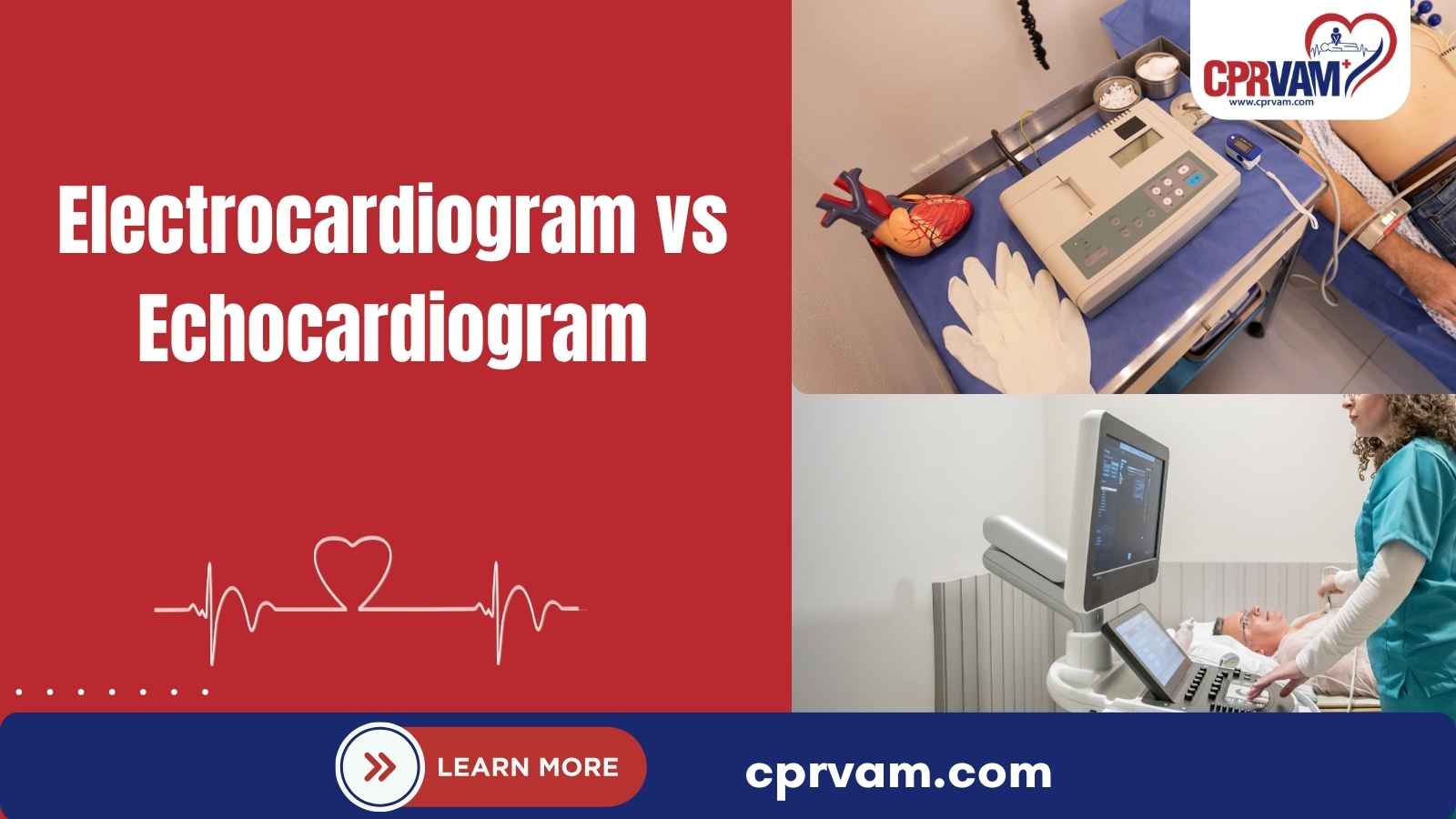
How Long Do ECG and Echocardiogram Tests Take?
A standard ECG (electrocardiogram/EKG) typically takes about 5-10 minutes in total. The actual recording takes only a few seconds, while the remaining time is generally used to position and attach the electrodes to the chest and limbs and prepare for the test.
A standard echocardiogram usually takes about 30-60 minutes. During the test, a healthcare professional applies gel to the chest and moves a handheld transducer over different areas to capture images of the heart’s chambers, valves, movement, and function. The exact time may vary by test type.
Rescue Breathing Cheat Sheet
Rescue breathing is used when a person has a pulse but is not breathing normally. It is also part of conventional CPR when cardiac arrest occurs. For healthcare professionals, the recommended breathing rate depends on the patient’s age.
Patient Group | Rescue Breathing Rate When a Pulse Is Present |
Adult | 1 breath every 6 seconds (10 breaths per minute) |
Child | 1 breath every 2-3 seconds (20–30 breaths per minute) |
Infant | 1 breath every 2-3 seconds (20–30 breaths per minute) |
Deliver each breath over approximately one second and look for visible chest rise. Avoid excessive ventilation, as breathing too quickly or forcefully can reduce the effectiveness of resuscitation.
Reassess the patient according to the applicable BLS algorithm. If the pulse becomes absent, transition to the appropriate CPR pathway. For a child or infant with a heart rate below 60 beats per minute and signs of poor perfusion despite adequate oxygenation and ventilation, trained healthcare professionals should follow the pediatric resuscitation algorithm and initiate CPR when indicated.
Clinical Reminder: These tables are educational references for BLS study and review. They do not replace hands-on training, instructor guidance, or current official AHA recommendations. In an emergency, activate local emergency services and follow dispatcher instructions and applicable protocols.
AED Use: Quick Reference Guide
An automated external defibrillator (AED) checks the heart’s rhythm and determines whether a shock is needed. Its voice and visual prompts guide rescuers through each step. Using an AED promptly, alongside high-quality CPR, can improve the chances of survival during sudden cardiac arrest.
1. How to Use an AED
Turn on the AED: Power on the AED and follow its voice and visual instructions.
Expose and Dry the Chest: Expose the person’s bare chest and quickly dry it if wet.
Attach AED Pads: Place the pads firmly on the bare chest according to the diagrams on the pads.
Analyze Heart Rhythm: Ensure everyone stands clear while the AED analyzes the heart rhythm.
Deliver a Shock If Advised: Follow the AED instructions and ensure no one touches the person during shock delivery.
Resume CPR: Restart CPR immediately after a shock or when no shock is advised.
Follow AED Prompts: Keep the AED on, leave the pads attached, and follow its instructions until emergency professionals take over.
2. AED Use in Children and Infants
Use pediatric pads or a pediatric dose attenuator when available and appropriate for the child’s age and the device instructions. If pediatric equipment is unavailable, do not delay defibrillation; use the available AED and follow its prompts and the applicable BLS algorithm.
When using adult pads on a small child or infant, ensure the pads do not touch each other. If necessary and supported by the device instructions, place one pad on the front of the chest and the other on the back.
Remember: An AED does not replace CPR. Begin or continue high-quality CPR while preparing and using the AED, and follow the device prompts until emergency responders arrive or take over.
Choking Relief Cheat Sheet
Choking occurs when a foreign object blocks the airway, making it difficult or impossible to breathe. The appropriate response depends on the person’s age, the severity of the blockage, and whether they remain responsive.
If the person can cough forcefully, encourage them to keep coughing and monitor their condition. If they cannot speak, breathe, or cough effectively, treat it as severe choking and act immediately.
1. Adult and Child Choking Relief
For adults and children with severe choking, the 2025 AHA guidelines recommend alternating 5 back blows with 5 abdominal thrusts.
Recognize Severe Choking: Look for signs such as an inability to speak, breathe, or cough effectively.
Call for Help: Activate emergency services or ask someone nearby to do so.
Give 5 Back Blows: Deliver firm blows between the shoulder blades.
Give 5 Abdominal Thrusts: If the blockage remains, perform five abdominal thrusts.
Repeat as Needed: Continue alternating five back blows and five abdominal thrusts until the object is expelled or the person becomes unresponsive.
For a pregnant person or someone whose abdomen cannot be encircled, use chest thrusts instead of abdominal thrusts.
2. Infant Choking Relief
For an infant younger than 1 year with severe choking, alternate 5 back blows with 5 chest thrusts.
Position the Infant Safely: Support the head and neck, then place the infant face down along your forearm, keeping the head lower than the chest.
Give 5 Back Blows: Use the heel of your hand to deliver firm blows between the shoulder blades.
Turn the Infant Face Up: Keep supporting the head and neck while turning the infant onto their back.
Give 5 Chest Thrusts: Use the heel of one hand on the center of the chest, just below the nipple line.
Repeat the Sequence: Continue alternating five back blows and five chest thrusts until the object is expelled or the infant becomes unresponsive.
Important: Never perform abdominal thrusts on an infant.
What to Do if the Person Becomes Unresponsive
If a choking person becomes unresponsive, lower them carefully onto a firm, flat surface and follow these steps:
Activate Emergency Services: Ask someone to call your local emergency number and bring an AED.
Begin CPR: Start with chest compressions and follow the appropriate CPR sequence.
Check for a Visible Object: Before giving breaths, open the mouth and remove an object only if you can see it and safely reach it.
Avoid blind Finger Sweeps: Never place your fingers inside the mouth to search for an unseen object.
Continue Resuscitation: Follow CPR and AED prompts, along with instructions from the emergency dispatcher, until help arrives or takes over.
Opioid-Related Emergency: BLS Quick Reference
An opioid overdose can slow or stop breathing and may lead to cardiac arrest. Recognizing the signs and responding quickly can help save a life.
What to Do if an Opioid Overdose Is Suspected
Check Scene Safety: Make sure the area is safe before approaching the person.
Check Responsiveness and Breathing: Try to get a response and check whether the person is breathing normally.
Activate Emergency Services: Call your local emergency number or ask someone nearby to call.
Provide Rescue Breathing or CPR: If the person is not breathing normally, provide rescue breathing if a pulse is present and you are trained to assess it. If cardiac arrest is suspected, begin CPR according to your training and the applicable BLS algorithm.
Administer Naloxone if Available: Give naloxone according to the product instructions and your training or local protocol.
Use an AED if Indicated: If cardiac arrest is suspected, use an AED as soon as one is available and follow its prompts.
Continue Care Until Help Arrives: Continue appropriate resuscitation, monitor the person, and follow emergency dispatcher instructions until professional help takes over.
Key Points to Remember: Healthcare professionals should follow the current adult or pediatric BLS algorithm to determine the appropriate response, including rescue breathing, CPR, and AED use.
Naloxone can reverse the effects of an opioid overdose, but it does not replace rescue breathing, CPR when indicated, or emergency medical care. Even if the person responds to naloxone, they still need urgent medical assessment because overdose symptoms can return.
High-Quality CPR: Essential Checklist
High-quality CPR helps keep blood flowing to the brain and other vital organs during cardiac arrest. To make each compression count, keep these key points in mind:
Start CPR Quickly: Begin chest compressions as soon as cardiac arrest is recognized and CPR is needed.
Keep a Steady Pace: Aim for 100–120 chest compressions per minute.Compress to the Right Depth: Follow the recommended compression depth for the person’s age and size.
Let the Chest Rise Fully: Allow the chest to return to its normal position after every compression, and avoid leaning on it between compressions.
Keep Pauses Short: Minimize interruptions to chest compressions, ideally keeping them under 10 seconds when possible.
Give Effective Breaths: Deliver each breath over about one second, using just enough air to make the chest visibly rise. Avoid giving breaths too quickly or forcefully.
Teamwork During CPR: Communicate clearly, assign CPR roles, and switch chest compressors every two minutes when possible.
- Use an AED as Soon as Possible: Attach the automated external defibrillator when it arrives and follow its instructions.
The main principles of high-quality CPR are similar for adults, children, and infants, but compression depth, hand placement, and breathing techniques vary by age. Always follow the appropriate BLS algorithm and current resuscitation guidelines.
Common BLS Mistakes to Avoid
Recognizing common mistakes can help you perform CPR more effectively and respond with greater confidence during an emergency. Keep these key points in mind when reviewing Basic Life Support (BLS) procedures.
Delaying CPR: Start CPR as soon as cardiac arrest is recognized and compressions are indicated. Avoid unnecessary delays caused by assessments or equipment retrieval.
Using the Wrong Compression Depth: Follow the recommended compression depth and technique for the person’s age and size.
Not Allowing Full Chest Recoil: Release pressure after each compression so the chest can return to its normal position.
Interrupting Compressions Too Often: Keep pauses as short as possible and coordinate tasks, rhythm checks, and compressor changes.
Giving Too Many Rescue Breaths: Deliver each breath over approximately one second, using enough air to produce visible chest rise without excessive ventilation.
Delaying AED Use: Arrange for an AED as soon as possible and use it promptly when available, following the device’s instructions.
Using Outdated Infant CPR Techniques: Review current recommendations for infant chest compressions and use the appropriate technique.
Following Outdated Choking Guidance: Learn the current recommended choking-relief procedures for adults, children, and infants.
Performing a Blind Finger Sweep: Never search inside the mouth with your fingers for an unseen object. Remove a foreign object only when it is visible and can be safely reached.
Relying on a Cheat Sheet Alone: Use BLS reference guides to reinforce your knowledge, but combine them with hands-on training, regular practice, instructor feedback, and current official guidelines.
BLS Cheat Sheet Review and Practical Application
A BLS cheat sheet provides a quick reference for essential life-support skills, including CPR, AED use, rescue breathing, pediatric resuscitation, and choking relief. Review the recommended compression rate, age-specific compression depth, and appropriate compression-to-breath ratios to strengthen your knowledge. Use this guide to prepare for certification exams and identify areas for improvement. Always follow current official AHA guidelines and supplement your review with hands-on training and regular practice.
Ready to strengthen your life-saving skills? CPR VAM provides BLS classes and training to help you develop practical CPR skills and prepare for certification. Enroll today to build confidence and improve your readiness to respond to emergencies.
FAQs About BLS Cheat Sheets
1. What Does BLS Stand For?
BLS stands for Basic Life Support. It includes essential emergency skills such as recognizing cardiac arrest, performing CPR, supporting breathing, and using an automated external defibrillator (AED). These skills help rescuers provide immediate care until advanced medical assistance arrives.
2. What is the Correct CPR Compression Rate and Depth?
The recommended compression rate for adults, children, and infants is 100-120 compressions per minute. Adults require a compression depth of at least 2 inches (5 cm), while children and infants require compressions to at least one-third of the chest’s front-to-back diameter. Correct depth, full chest recoil, and minimal interruptions are essential for effective CPR.
3. What are the CPR Compression-To-Breath Ratios?
For adults and single-rescuer CPR on children or infants, use 30 compressions followed by 2 breaths. For two-rescuer CPR on children or infants, use 15 compressions followed by 2 breaths. These ratios apply to conventional CPR without an advanced airway; follow the appropriate BLS algorithm for each situation.
4. When Should an AED Be Used?
Use an automated external defibrillator (AED) as soon as it is available when cardiac arrest is suspected. Follow its voice and visual prompts, ensure everyone is clear during rhythm analysis and shock delivery, and resume CPR as directed. Early AED use alongside high-quality CPR can improve the chances of survival.
5. Can a BLS Cheat Sheet Help Me Prepare for Certification?
A BLS cheat sheet helps you review essential procedures, CPR guidelines, AED use, and emergency response steps. It can reinforce your knowledge and help you identify topics that need further practice. However, it does not replace an approved training course, hands-on practice, or the assessments required for certification.