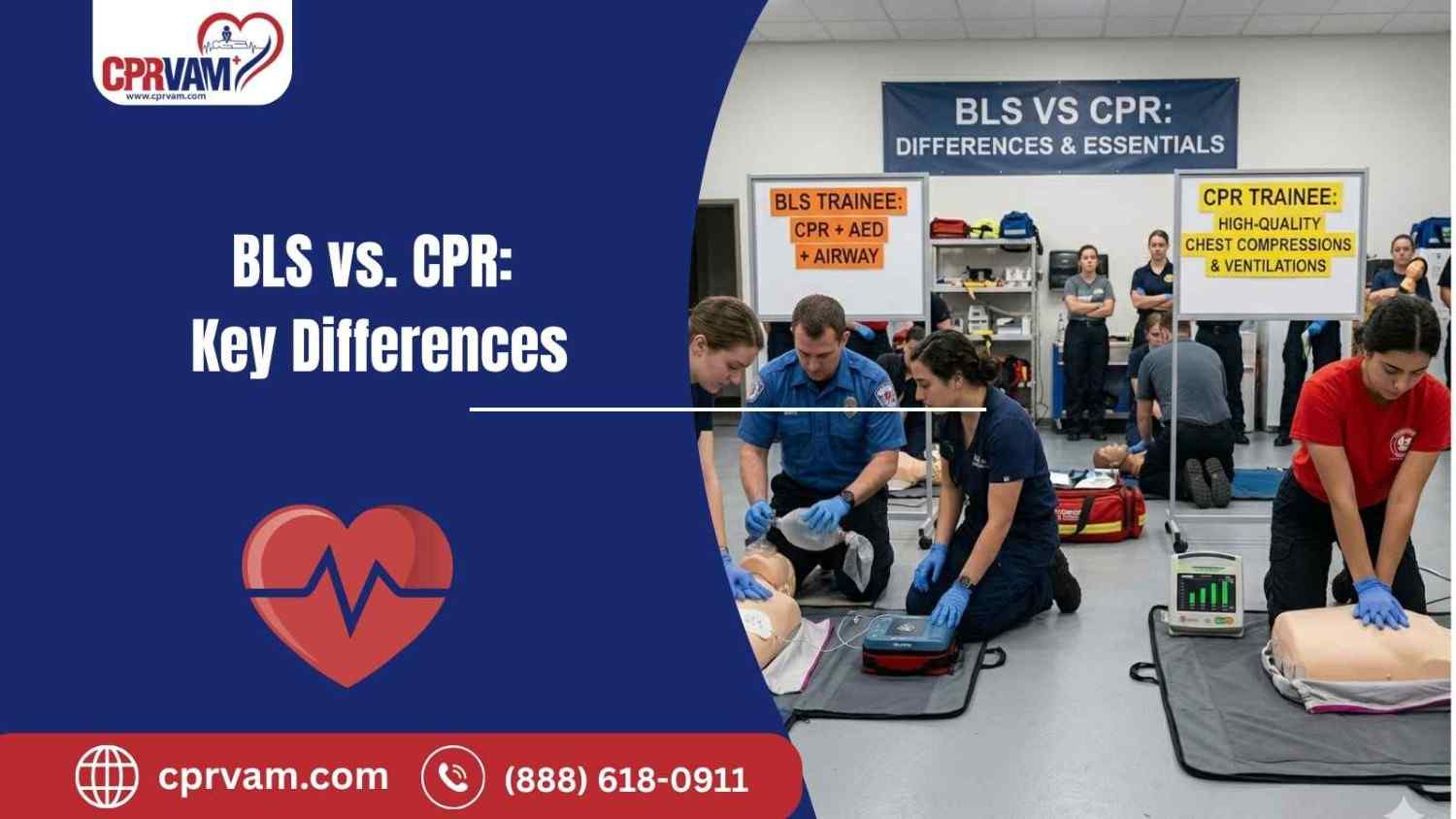
CPR (Cardiopulmonary Resuscitation) is an emergency lifesaving skill used to help someone experiencing cardiac arrest. BLS (Basic Life Support) is a broader training course that includes CPR and teaches additional skills, such as using a bag-mask device, working as part of a resuscitation team, and responding to other life-threatening emergencies.
If you are a parent, teacher, fitness trainer, or other member of the public, a CPR course may meet your needs. If you work in healthcare or are preparing for a clinical role, you may need an AHA BLS Provider course instead.
At a Glance: Which Course Is Right for You?
- CPR/Heartsaver: Often suitable for parents, teachers, childcare workers, fitness professionals, and workplace responders
- BLS Provider: Often suitable for nurses, physicians, EMTs, dental professionals, and healthcare students
Not sure? Check your employer’s or training program’s requirements before enrolling.
Choosing the right course matters. The goal is not simply to earn a card. It is to learn the skills you may need to respond confidently when someone faces a medical emergency.
What Is CPR?
CPR stands for Cardiopulmonary Resuscitation. It is an emergency procedure used when a person’s heart stops beating effectively, and they are unresponsive and not breathing normally.
During cardiac arrest, blood stops circulating properly. This means the brain and other vital organs do not receive the oxygen they need. CPR helps maintain blood flow until emergency medical services arrive and advanced treatment can be provided.
CPR is a skill, not a separate professional license. People can learn it through different training courses, including courses designed for the general public and courses intended for healthcare professionals.
Who Should Learn CPR?
CPR training can be valuable for almost anyone. It is especially useful for people who may be responsible for the safety of others.
Examples include:
- Parents and Caregivers: To respond if a child or another family member experiences a cardiac emergency
- Teachers and School Staff: To help prepare for emergencies involving students, colleagues, or visitors
- Daycare Workers: To learn age-appropriate emergency response skills for children in their care
- Fitness Trainers and Coaches: To prepare for medical emergencies that may happen during physical activity
- Workplace Employees: To support emergency response plans and help coworkers or visitors
- Community Members: To become more prepared to help someone in a public setting
What Skills Does a CPR Course Teach?
Course content depends on the training program. An AHA Heartsaver CPR AED course, for example, is designed for people with little or no medical training.
Depending on the course format and selected options, training may cover:
- Recognizing the signs of cardiac arrest
- Performing high-quality CPR
- Giving appropriate chest compressions
- Providing rescue breaths when included in the course
- Using an automated external defibrillator (AED)
- Responding to choking emergencies
- Recognizing warning signs of a heart attack or stroke
Some course options include CPR skills for adults, children, and infants. Check the course description to confirm which age groups and skills are covered before registering.
What Is BLS?
BLS stands for Basic Life Support. It is a structured training course that teaches people how to recognize and respond to life-threatening emergencies, with a strong focus on high-quality CPR and coordinated resuscitation.
BLS includes CPR, but it covers more than chest compressions alone. It prepares healthcare professionals and other trained responders to provide emergency care individually and as part of a team.
The AHA BLS Provider course is primarily intended for healthcare professionals, trained first responders, and people enrolled in healthcare training programs.
Who Should Take a BLS Certification Course?
BLS training is commonly required or recommended for people working in clinical and emergency care settings.
Common examples include:
- Registered Nurses (RNs): Nurses who provide direct patient care may need a current BLS Provider card
- Physicians and Medical Professionals: Many clinical roles require BLS training as part of workplace or credentialing requirements
- Emergency Medical Technicians (EMTs): BLS skills support emergency response and patient care
- Dental Professionals: Dentists and dental staff may need BLS training depending on their role and employer
- Nursing and Healthcare Students: Training programs may require a BLS Provider card before clinical placements
- Other Healthcare Workers: Medical assistants, respiratory therapists, and other clinical staff may need BLS based on workplace policy
Requirements are not identical across every job, employer, or state. Always confirm the exact course your organization accepts.
What Skills Will You Learn in a BLS Provider Course?
An AHA BLS Provider course develops the skills needed to respond to cardiac and respiratory emergencies in healthcare settings.
Training includes:
- High-Quality CPR: Performing effective chest compressions and providing appropriate ventilation
- AED Use: Using an automated external defibrillator as part of a resuscitation response
- Rescue Breathing and Ventilation: Providing breaths using appropriate techniques and equipment
- Bag-Mask Ventilation: Practicing ventilation with a bag-mask device, including coordination between rescuers
- Multi-Rescuer CPR: Working with other responders to provide effective, coordinated care
- Team Dynamics: Communicating clearly, assigning roles, and working together during a resuscitation
- Choking Response: Recognizing and responding to foreign-body airway obstruction
BLS training places particular emphasis on teamwork because healthcare emergencies often require several people to act quickly and communicate clearly.
BLS vs. CPR: Side-by-Side Comparison
The main difference is the scope of training and the audience each course is designed to serve.
Comparison | CPR/Heartsaver CPR AED | AHA BLS Provider |
Full Name | Cardiopulmonary Resuscitation | Basic Life Support |
Primary Audience | General public, parents, teachers, workplace responders | Healthcare professionals, trained first responders, healthcare students |
Core Skills | CPR, AED use, and other skills depending on course options | High-quality CPR, AED use, ventilation, choking response, and team resuscitation |
Ventilation Equipment | Depends on the specific course | Includes training with a bag-mask device |
Team Resuscitation | Basic emergency response; course content varies | Includes coordinated, multi-rescuer resuscitation and team dynamics |
AHA Course Card Validity | Heartsaver CPR AED card: 2 years | BLS Provider eCard: 2 years |
Typical Job Requirements | May be requested for schools, childcare, fitness, and workplace roles | Commonly required for clinical and healthcare positions |
Important: CPR and BLS course content can vary by provider and course option. The comparison above describes the general distinction and the relevant AHA course types, not every CPR class available.
Which Course Do You Need?
The right course depends on your job, responsibilities, and the requirements of your employer or training program.
Choose CPR/Heartsaver If You're a Non-Healthcare Professional
A CPR or AHA Heartsaver CPR AED course may be appropriate if you:
- Are a parent or family caregiver who wants to learn emergency response skills
- Work as a teacher, school employee, or coach
- Are a fitness trainer, gym employee, or sports instructor
- Work in daycare or childcare
- Need CPR and AED training for a workplace safety requirement
- Want to learn how to help during a cardiac emergency but do not work in a healthcare role
An AHA Heartsaver CPR AED course is designed for people with little or no medical training. Confirm that the course includes the specific skills and age groups relevant to your responsibilities.
Choose BLS Training If You Are a Healthcare Professional
An AHA BLS Provider course may be the right choice if you:
- Work as a registered nurse
- Are a physician or other healthcare professional
- Work as an EMT or trained first responder
- Are a dental professional whose employer requires BLS
- Are a nursing, medical, or other healthcare student
- Need training in healthcare-level CPR, ventilation, and team resuscitation
BLS is commonly required in clinical settings, but do not assume every healthcare position has the same requirement. Your employer, school, licensing organization, or clinical placement program determines which course you need.
Pro Tip: Check Before You Register
Contact your employer, school, or licensing organization before paying for a course. Ask whether they require an AHA BLS Provider eCard, an AHA Heartsaver CPR AED card, or another specific credential. A course that teaches useful skills may still not meet your organization’s documentation requirements.
CPR and BLS Training Formats
CPR and BLS courses may be available in different formats. The best option depends on your schedule, learning preferences, and the requirements of the organization accepting your course card.
1. Classroom Training
Classroom training takes place in person with an instructor. Participants learn the course material, practice skills, and complete the required assessments during scheduled sessions.
Benefits include:
- Direct instruction from a qualified instructor
- Hands-on practice with training equipment
- Opportunities to ask questions and receive feedback
- In-person skills assessment when required
This format can be helpful if you prefer guided learning and direct feedback.
2. Blended Learning
Blended learning combines an online learning portion with an in-person skills session. You complete the online coursework at your own pace, then attend a hands-on session to demonstrate the required skills.
For applicable AHA courses, completing the online portion alone is not enough to receive the course completion card. You must also complete the required in-person skills session.
Blended learning may suit people who:
- Have busy work or study schedules
- Prefer completing the knowledge portion online
- Want flexibility while still receiving hands-on skills training
3. On-Site Training
On-site training allows an organization to arrange training at its own workplace, school, or facility. A training provider may deliver instruction to a group of employees at an agreed location.
This option can be useful for:
- Hospitals and clinics
- Schools and childcare centers
- Dental offices
- Fitness facilities
- Businesses with workplace safety programs
Ask the training provider whether the course meets your organization’s requirements and whether each participant receives the appropriate course completion card.
Can You Get CPR or BLS Certified Online?
This is one of the most common questions about CPR and BLS training. An online course can teach important knowledge, but an online-only course without the required hands-on skills assessment is not equivalent to an AHA course that includes skills practice and evaluation.
CPR and BLS involve physical skills. Participants must learn how to perform compressions, provide appropriate ventilation, and use equipment correctly. These skills cannot be fully demonstrated through online lessons alone.
For applicable AHA Heartsaver and BLS Provider course formats, blended learning includes an online component followed by an in-person skills session. The required steps must be completed to receive the corresponding AHA course completion card.
Before enrolling in an online course, check:
- Is the course offered by an AHA Training Center or another provider accepted by your employer?
- Does it include the required hands-on skills session?
- Will you receive the specific course card your employer or school requires?
- Does the course cover the correct level of training?
Be cautious of websites promising instant CPR or BLS certification without any skills practice when your organization requires an AHA course card.
Choose the Right Training and Be Ready to Respond
CPR and BLS training both prepare people to respond during life-threatening emergencies, but they are designed for different needs. CPR or Heartsaver training is often a good fit for members of the public, parents, teachers, and workplace responders. BLS Provider training offers broader resuscitation skills for healthcare professionals and others whose roles require it.
Before choosing a course, consider your responsibilities and confirm the exact credential your employer, school, or licensing organization accepts. The right training helps you build practical skills, understand your role during an emergency, and respond with greater confidence.
Ready to learn lifesaving skills? Join CPR VAM Training Center for an AHA BLS or Heartsaver CPR course. We’ll help you build the skills and confidence to respond when it matters most.
FAQs About BLS vs CPR
1. Is BLS Harder Than CPR?
BLS is generally more comprehensive than a basic CPR course. It includes high-quality CPR along with additional training in ventilation, AED use, choking response, and team-based resuscitation. The difficulty depends on your experience, training, and comfort with the skills.
2. Does BLS Include CPR?
Yes. CPR is a core component of BLS training, but BLS covers much more than chest compressions. It also includes rescue breathing, AED use, team-based resuscitation, and responding to life-threatening emergencies in healthcare settings.
3. Can I perform CPR without a Certification eCard in an Emergency?
Yes. You do not need a CPR or BLS course card to help someone experiencing a suspected cardiac arrest. Call 911, follow the emergency dispatcher’s instructions, and begin CPR if the person is unresponsive and not breathing normally. Use an AED if one is available and follow its prompts.
4. How Long is an AHA CPR or BLS Card Valid?
AHA Heartsaver CPR AED and BLS Provider course completion cards are generally valid for two years. Check the expiration date on your card and your employer’s renewal policy so you can complete any required training on time.
5. Can I Take BLS If I am Not a Healthcare Professional?
The AHA BLS Provider course is primarily designed for healthcare professionals, trained first responders, and people enrolled in healthcare training programs. If you are not in one of these groups, a Heartsaver CPR AED course may be more appropriate. Check the course eligibility and your organization’s requirements before enrolling.