


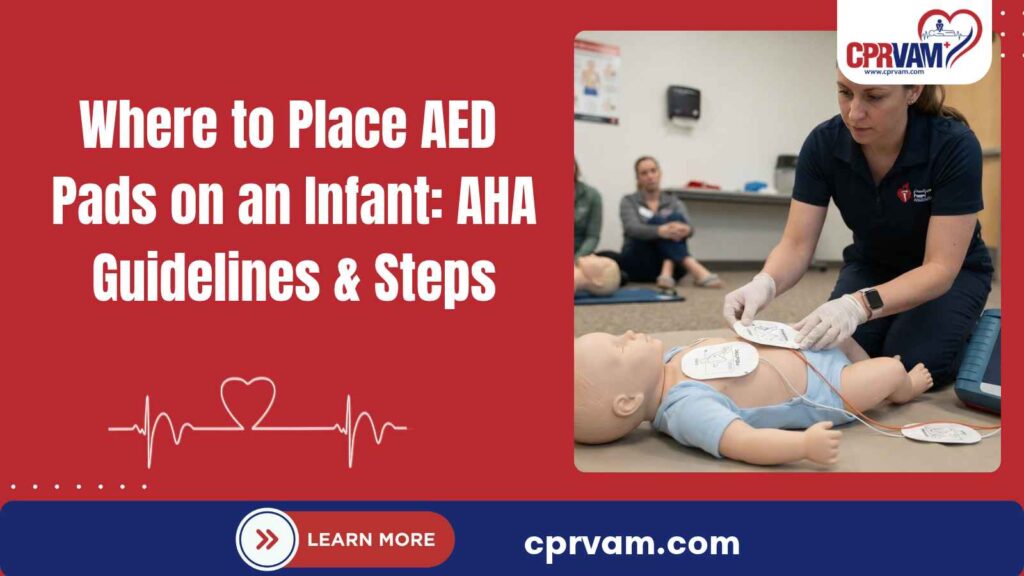
When an infant goes into cardiac arrest, knowing where to place AED pads on an infant can help you respond quickly and correctly. For infants, anteroposterior (front-and-back) pad placement is commonly used because it helps keep the AED pads separated on a small chest. Anterolateral placement may also be reasonable when the pads fit properly without touching. Always follow the AED manufacturer’s instructions.
Current AHA/AAP guidance recognizes that either anteroposterior or anterolateral placement may be reasonable when the pads fit appropriately and remain separated. Use pediatric pads or a pediatric attenuator when available, and follow the specific AED’s instructions.
This blog explains the correct AED pad placement for infants, safe pad positioning, and current AHA/AAP and ILCOR recommendations for using an AED effectively during a pediatric cardiac emergency.
What Is the Correct AED Pad Placement for an Infant?
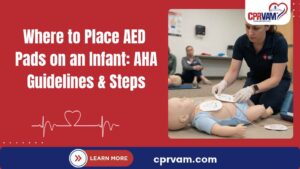
Anteroposterior (AP) placement means positioning one AED pad on the infant’s chest and the other on the back. This configuration can help maintain adequate separation between the pads on a small torso.
- Front Pad: Place it on the bare chest according to the AED’s placement diagram.
- Back Pad: Position it on the back as directed by the device.
- Pad Separation: Keep the pads from touching or overlapping.
- Skin Contact: Apply the pads firmly to clean, dry skin.
- AED Instructions: Follow the device’s voice prompts and visual guidance.
Current resuscitation guidance supports anteroposterior placement as an appropriate option for infants and young children when it allows adequate pad separation. Position the pads according to the AED’s placement diagram rather than relying on a single anatomical configuration for every device.
AHA/AAP guidance also recognizes anterolateral placement as reasonable when the pads fit appropriately and remain separated. The priority is to use the available AED correctly and follow its specific placement instructions.
Why Is Anteroposterior Placement Used for Infants?
Anteroposterior placement can be useful for infants because their small chest may limit the space available for front-and-side pad positioning. Placing one pad on the chest and the other on the back can help maintain adequate separation.
Key Considerations for Infant AED Pad Placement
- Small Chest: Limited space can make front-and-side placement more difficult.
- Pad Separation: Keep the pads from touching or overlapping.
- Proper Fit: Use pads that fit the infant appropriately.
- Skin Contact: Apply pads to clean, dry, bare skin.
- Pediatric Equipment: Use pediatric pads or a pediatric attenuator when available.
- Device Guidance: Follow the AED’s placement diagram and prompts.
For infants, AP placement can help maintain pad separation on a small chest. Always use the configuration shown by the AED and make sure the pads have proper skin contact.
How to Place AED Pads on an Infant
If an infant is unresponsive and not breathing normally, start CPR, activate emergency medical services, and use an AED as soon as one is available. Follow the device prompts throughout the resuscitation.
Here are the steps for correctly placing AED pads on an infant:
1. Turn On the AED
Turn on the AED as soon as it is available. Listen to the voice prompts and follow the visual instructions throughout the resuscitation.
2. Expose the Infant’s Chest
Remove clothing from the infant’s chest where the AED pads will be placed. The pads must make direct contact with bare skin. If the chest is wet, quickly dry the skin before applying the pads to help ensure proper contact and effective AED operation.
3. Use Pediatric Pads When Available
Use pediatric pads, a pediatric attenuator, or the AED’s pediatric mode when available. Follow the specific instructions for the device you are using.
4. Place the AED Pads Correctly
For anteroposterior (AP) placement, place one pad on the infant’s chest and the other on the back. Follow the AED’s placement diagram, keep the pads separated, and ensure good contact with the skin.
5. Check Pad Size and Separation
Use AED pads that fit the infant’s chest while allowing adequate separation between them. Keep the AED pads adequately separated and make sure they do not touch or overlap. Follow the device’s placement diagram to achieve the appropriate positioning for the infant.
6. Let the AED Analyze the Rhythm
Follow the AED’s prompts for rhythm analysis. When instructed, make sure no one is touching the infant while the device analyzes the heart rhythm.
7. Deliver a Shock if Advised
If a shock is advised, make sure everyone is clear and no one is touching the infant. Deliver the shock only when instructed by the AED.
8. Resume CPR
After a shock or when no shock is advised, resume CPR as directed by the AED. Continue following the device prompts until emergency medical professionals take over.
Can You Use an AED Without Pediatric Pads on an Infant?
Pediatric pads or an AED with a pediatric attenuator are preferred for infants when available. However, if pediatric equipment is unavailable, an AED without pediatric attenuation may be considered rather than delaying defibrillation when a shockable rhythm is present.
Follow the AED manufacturer’s instructions for pad selection and placement. Make sure the pads fit appropriately, remain separated, and have good contact with the infant’s bare skin.
Do not delay lifesaving resuscitation simply because pediatric AED equipment is unavailable.
Pediatric vs. Adult AED Pads
Feature | Pediatric AED Setup | Adult AED Setup |
Intended Use | Infants and young children when pediatric equipment is available | Larger children and adults according to device guidance |
Energy | Pediatric attenuation when available | Adult energy setting |
Pad Size | Designed to fit smaller patients | Designed for larger patients |
Placement | Follow the AED’s instructions; AP placement is recommended for standardization in infants and young children | Follow the AED’s instructions; anterolateral placement is commonly used |
Main Concern | Proper pad fit, separation, and skin contact | Correct positioning, adequate separation, and skin contact |
Common AED Pad Placement Mistakes to Avoid
Avoiding common AED pad placement mistakes is essential to ensure proper pad contact, deliver an effective shock when needed, and support safe and effective defibrillation during infant cardiac emergencies.
Placing Pads Over Clothing
AED pads must be placed directly on bare skin. Remove clothing from the pad placement area before applying the pads.Allowing Pads to Touch
Keep the pads separated and make sure they do not touch or overlap. This is especially important when working with an infant’s small chest.Applying Pads to Wet Skin
If the infant’s chest is wet, quickly dry the area before applying the pads so they can adhere properly.Ignoring the AED’s Placement Diagram
AED models may use different pad configurations. Check the device’s placement diagram and follow its instructions rather than assuming the same positioning applies to every AED.Waiting Too Long to Use the AED
Use the AED as soon as it is available. Do not delay treatment while waiting for a particular pad configuration or pediatric equipment.Touching the Infant During Analysis or Shock
Do not touch the infant during rhythm analysis or shock delivery. Wait for the AED to indicate when it is safe to resume CPR.
Do not touch the infant during rhythm analysis or shock delivery. Wait for the AED to indicate when it is safe to resume CPR.
Learn the Right CPR and AED Skills Before an Emergency
Knowing where to place AED pads on an infant, maintaining proper pad separation, and following AHA/AAP recommendations are essential for safe and effective defibrillation. Use pediatric pads when available, follow the AED manufacturer’s instructions, and resume CPR as directed. Hands-on AHA CPR and AED training can help you build the practical skills and confidence needed to respond effectively during an infant cardiac emergency.
If you’re ready to strengthen your CPR and AED skills, CPR VAM provides hands-on AHA training, including the Heartsaver CPR AED course, where you can practice essential lifesaving techniques in a supportive training environment. Explore the available CPR courses and choose the training that best fits your role and needs.
FAQs About AED Pad Placement for Infants
1. What If Adult AED Pads Are Too Large for an Infant?
Use pads that are appropriate for the infant and fit properly on the available chest area. Follow the AED manufacturer’s placement instructions and make sure the pads do not touch or overlap. Position the pads according to the AED’s instructions and placement diagram. Do not allow the pads to touch, overlap, or extend beyond an appropriate area of the chest.
2. Do AED Pads Have to Touch an Infant’s Skin?
Yes. AED pads should be applied directly to clean, dry, bare skin. Remove clothing from the placement area and quickly dry the skin if it is wet.
3. Should CPR Continue While the AED is Being Prepared?
Yes. Start CPR promptly and continue while the AED is being prepared. Once the AED is ready, follow its prompts and minimize interruptions to chest compressions.
4. What is the Most Important Thing to Remember About Infant AED Pad Placement?
The most important points are to use appropriate equipment when available, follow the AED’s placement diagram, and keep the pads properly separated on the infant’s bare skin. For AP placement, one pad is placed on the chest and the other on the back.
5. Can You Put an AED Pad Over an Infant’s Heart?
No. Do not position an AED pad simply by placing it directly over the heart. Use the placement configuration shown by the AED manufacturer, such as anteroposterior or anterolateral placement, and apply the pads to bare skin as directed.