
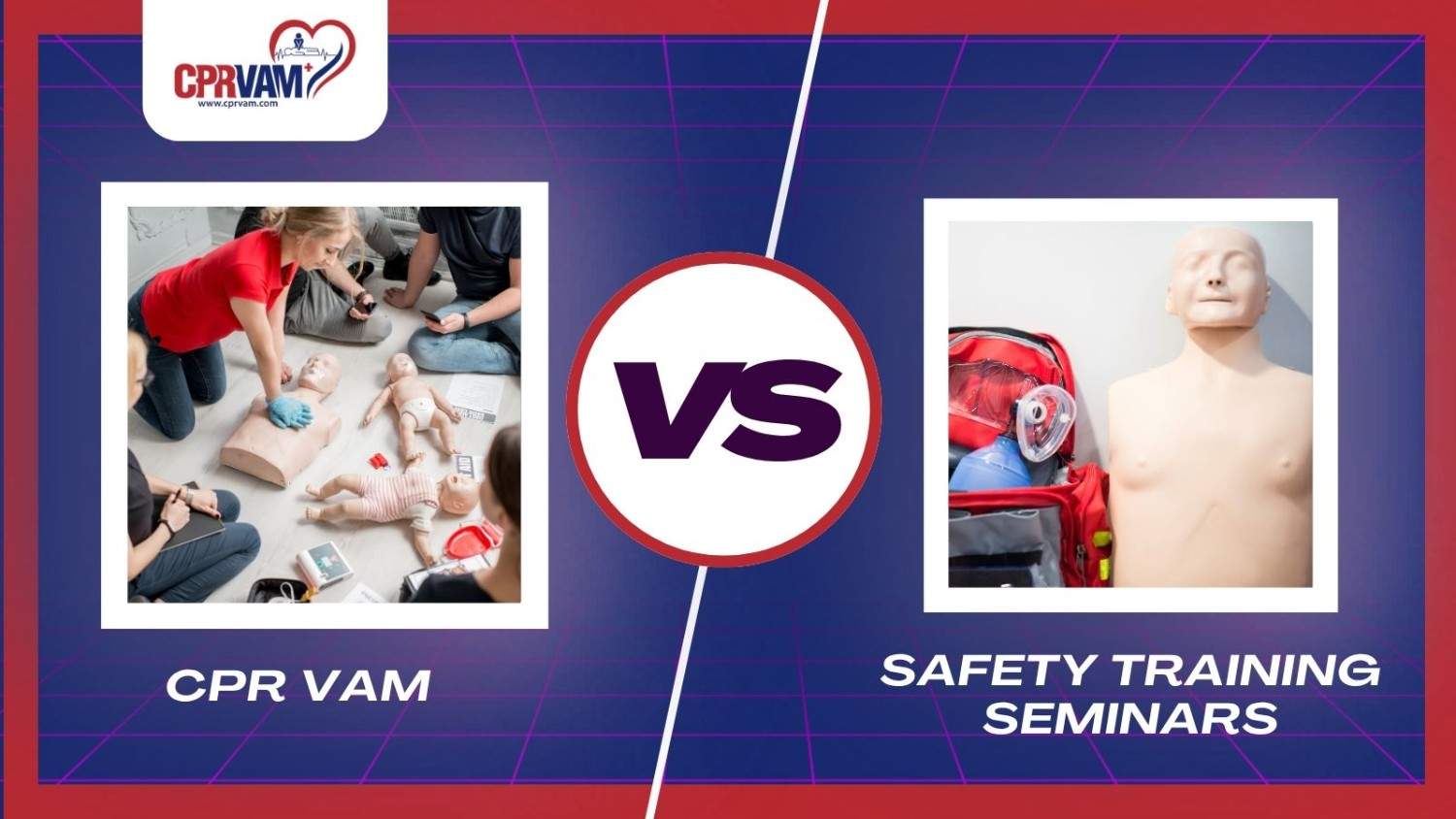
Healthcare professionals comparing hybrid American Heart Association certification providers often look at CPR VAM and Safety Training Seminars for BLS, ACLS, and PALS training.
Both offer AHA-aligned blended learning pathways with online coursework and hands-on skills validation. Both also emphasize convenience, same-day certification, and technology-supported training.
So how do they differ?
This comparison breaks down the differences in training model, convenience, course variety, and who each provider may be best suited for.
Overview of Each Provider
CPR VAM
- Blended learning model: online coursework + ~30-minute skills session
- Uses Voice Assisted Manikins (VAM) for self-guided testing
- Instant AHA eCard upon completion
- Focus on speed, flexibility, and convenience
- Serves multiple U.S. states with flexible scheduling
Safety Training Seminars
- Blended learning model: online coursework + ~30-minute skills session
- Uses Voice Assisted Manikins (VAM) for self-guided testing
- Instant AHA eCard upon completion
- Focus on speed, flexibility, and convenience
- Serves multiple U.S. states with flexible scheduling
Quick Comparison: CPR VAM vs Safety Training Seminars
Feature | CPR VAM | Safety Training Seminars |
Certification Type | AHA-certified (BLS, ACLS, PALS, CPR) | AHA-certified + additional programs (NRP, Bloodborne pathogens courses, EMSA) |
Training Format | Online + self-paced VAM skills session | Online + in-person skills session |
Skills Session Time | ~30 minutes | ~30 minutes – 1 hours (Varies by course) |
Scheduling | 7 days/week, flexible | Daily classes, scheduled sessions |
Certification Delivery | Instant AHA eCard | Same-day AHA card |
Flexibility | Self-paced + 7-day availability with weekend and night scheduling options | Daily classes + scheduled sessions |
Locations | Multi-state (10 states) including California | More Focused on California |
Pass Rate | 100% with unlimited attempts | Not specified |
Pricing (BLS) | ~$80–$110 | ~$120 |
Pricing (ACLS/PALS) | ~$150–$280 | ~$290 |
Learning Experience | Fast, automated, low-stress | Traditional structured training |
Target Audience | Busy professionals, renewals, flexible learners | Students wanting structured classes |
1. Convenience & Speed
When it comes to CPR certification, convenience and time commitment are often the deciding factors, especially for busy healthcare professionals.
CPR VAM
CPR VAM is built specifically for speed and flexibility. Students complete the cognitive portion online at their own pace, then finish with a hands-on skills session that typically takes less than 30 minutes.
- Available 7 days a week with flexible scheduling
- Uses Voice Assisted Manikin (VAM) for fast, self-guided completion
This model eliminates long classroom sessions and allows students to complete certification on their own schedule.
Safety Training Seminars
Safety Training Seminars also offers AHA blended learning, but the experience is generally more schedule-dependent.
- Requires booking a specific in-person skills session
- Often follows a more structured, location-based format
- Still offers same-day certification, but less emphasis on ultra-fast completion
2. Pricing & Value
Pricing is one of the biggest deciding factors when choosing a CPR certification provider—but true value goes beyond just the upfront cost. It includes pass rates, flexibility, retake policies, and what you actually get for your money.
CPR VAM
CPR VAM positions itself as a cost-effective, high-value option, especially for healthcare professionals who need fast certification without overpaying.
- BLS: ~$80–$110
- ACLS / PALS: ~$150–$280
- Unlimited attempts + 100% pass rate included
- Includes instant certification on completion
This means students are not paying extra for retakes or remediation, which can significantly increase real-world value.
Safety Training Seminars
Safety Training Seminars offers competitive pricing with a price-match guarantee, but base costs are generally higher.
- BLS: ~$120
- ACLS: ~$290
- PALS: ~$290
- Includes same-day certification and structured training
While they offer reliability and multiple locations, the upfront pricing is typically at the higher end of the market.
3. Learning Experience
The learning experience is where CPR providers truly differentiate themselves—not just in how content is delivered, but in how confident and prepared students feel after completing the course.
CPR VAM
CPR VAM is designed around a modern, low-stress, self-directed learning model that prioritizes comfort and efficiency.
- Self-paced online modules allow students to learn at their own speed without classroom pressure
- Hands-on training uses Voice Assisted Manikins (VAM) that guide you step-by-step with real-time feedback
- No instructor watching during skills testing → reduced anxiety and more confidence
- Unlimited attempts help reinforce skills until mastery is achieved
- Consistently described as “easy,” “smooth,” and “no stress” by students
From a training science perspective, VAM-based learning can actually improve skill acquisition by giving continuous, objective feedback during practice, rather than relying solely on instructor observation .
👉 Overall experience:
Flexible, pressure-free, and optimized for independent learners
Safety Training Seminars
Safety Training Seminars delivers a more traditional, instructor-supported blended learning experience.
- Online learning combined with in-person, instructor-led skills validation
- Hands-on sessions include real-time coaching and corrections from certified instructors
- Structured environment with guided practice, scenarios, and team-based training
- Emphasis on hands-on repetition and instructor feedback for skill confidence
This approach aligns with traditional CPR education, where direct instructor feedback and guided correction can help learners refine technique and build confidence in real-world scenarios.
4. Availability & Reach
Availability isn’t just about how many locations a provider has—it’s about how easily students can access training across regions, how often sessions run, and how flexible those locations are.
CPR VAM
CPR VAM is built for broad geographic access combined with high scheduling flexibility.
- Operates across 10+ U.S. states, including Arizona, California, Colorado, Idaho, Nevada, New Mexico, Oregon, Texas, Utah, and Washington
- Multiple training sites within each state (especially strong presence in California)
- Many locations offer 7-day availability and even 24/7 access for skills sessions
- Designed for on-demand certification, not limited to fixed class schedules
👉 This makes CPR VAM especially attractive for:
- Traveling professionals
- Multi-state employers
Anyone needing last-minute or off-hour certification
Safety Training Seminars
Safety Training Seminars focuses on high-density coverage within a single state (California).
- Operates 70+ locations primarily across California (widely distributed in major cities and suburbs)
- Strong presence in cities like Sacramento, San Jose, Elk Grove, Livermore, and more (as seen in multiple local listings and community references)
- Offers daily classes with scheduled time slots, including mornings and evenings
- Ideal for students who want a nearby physical location with consistent availability
👉 This model works well for:
- California-based healthcare workers
- Students who prefer frequent in-person options nearby
Organizations needing local group training
5. Course Selection
Course selection matters because it determines whether a provider can meet all your certification needs in one place—or if you’ll need multiple providers for different credentials.
CPR VAM
CPR VAM focuses on core American Heart Association (AHA) certifications, delivering a streamlined set of essential courses for most healthcare professionals.
- BLS (Basic Life Support)
- ACLS (Advanced Cardiovascular Life Support)
- PALS (Pediatric Advanced Life Support)
- CPR / AED & First Aid training (primarily via group or workplace training)
All courses follow the AHA HeartCode blended learning format, combining online coursework with a short in-person skills session.
👉 Key strength:
- Focused, high-demand certifications
- Optimized for speed, efficiency, and repeat certifications (renewals)
👉 Limitation:
Does not offer many specialty or niche healthcare certifications
Safety Training Seminars
Safety Training Seminars offers a broader catalog of courses, going beyond the core AHA certifications.
In addition to:
- BLS
- ACLS
- PALS
- CPR / First Aid
They also commonly provide:
- NRP (Neonatal Resuscitation Program)
- EMSA Pediatric First Aid & CPR (for childcare providers)
- Other specialized or compliance-based certifications
👉 Key strength:
- Wider range of certifications for different professions and regulatory requirements
👉 Trade-off:
- Less streamlined—more options, but not as focused on speed or simplicity
Which Should You Choose?
Choose CPR VAM if you prioritize:
- Fast, streamlined certification
- Flexible renewal-focused training
- Self-guided skills testing
- Efficiency with minimal disruption
- Available across multiple states (not just one region)
- Typically lower pricing + unlimited attempts
- Courses designed for busy professionals who want fast certification
CPR VAM may be ideal for busy clinicians and repeat renewals.
Choose Safety Training Seminars if you prioritize:
- Broader course offerings
- Larger provider network
- Offers instructor-supported, structured skills sessions
- Those who want a traditional classroom-style experience
Safety Training Seminars may appeal if you want flexibility in format and broader offerings.
Bottom Line
Both CPR VAM and Safety Training Seminars offer strong AHA certification pathways.
The difference often comes down to specialization vs scale:
CPR VAM → optimized for efficiency, streamlined renewals, and focused healthcare certification.
Safety Training Seminars → optimized for training variety, network scale, and format flexibility.
For experienced healthcare professionals needing fast renewal with minimal disruption, CPR VAM may be the more efficient choice.
For learners wanting broader training options or a larger multi-format provider, Safety Training Seminars may be the better fit.