



CPRvam Students
25,000+ students successfully trained annually
Step-by-step treatment algorithms

Early recognition of pediatric cardiac arrest is critical for initiating life-saving care without delay. Infants and children may show sudden collapse, unresponsiveness, abnormal or absent breathing, and no detectable signs of circulation. Identifying these warning signs quickly allows immediate activation of resuscitation and improves the chances of survival and recovery.

Key Signs and Symptoms:

  • Unresponsiveness to voice or physical stimulation
  • Absence of normal breathing or only gasping respirations
  • No signs of circulation (no movement, coughing, or normal breathing)
  • Pale, mottled, or cyanotic skin appearance
  • Absent palpable pulse
  • Dilated or nonreactive pupils
  • Loss of muscle tone (limp or floppy presentation)
  • Absent or abnormal heart sounds on auscultation
  • Cardiac rhythms such as asystole, pulseless electrical activity (PEA), ventricular fibrillation (VF), or pulseless ventricular tachycardia (pVT)

Pediatric cardiac arrest management follows a clear, structured approach to ensure timely and effective care. It focuses on quick assessment, high-quality CPR, early defibrillation when needed, and the correct use of medications. Ongoing reassessment throughout the process helps guide treatment decisions and improves the chances of return of spontaneous circulation (ROSC) and survival.

Here are the step-by-step protocols for treating Pediatric Cardiac Arrest:

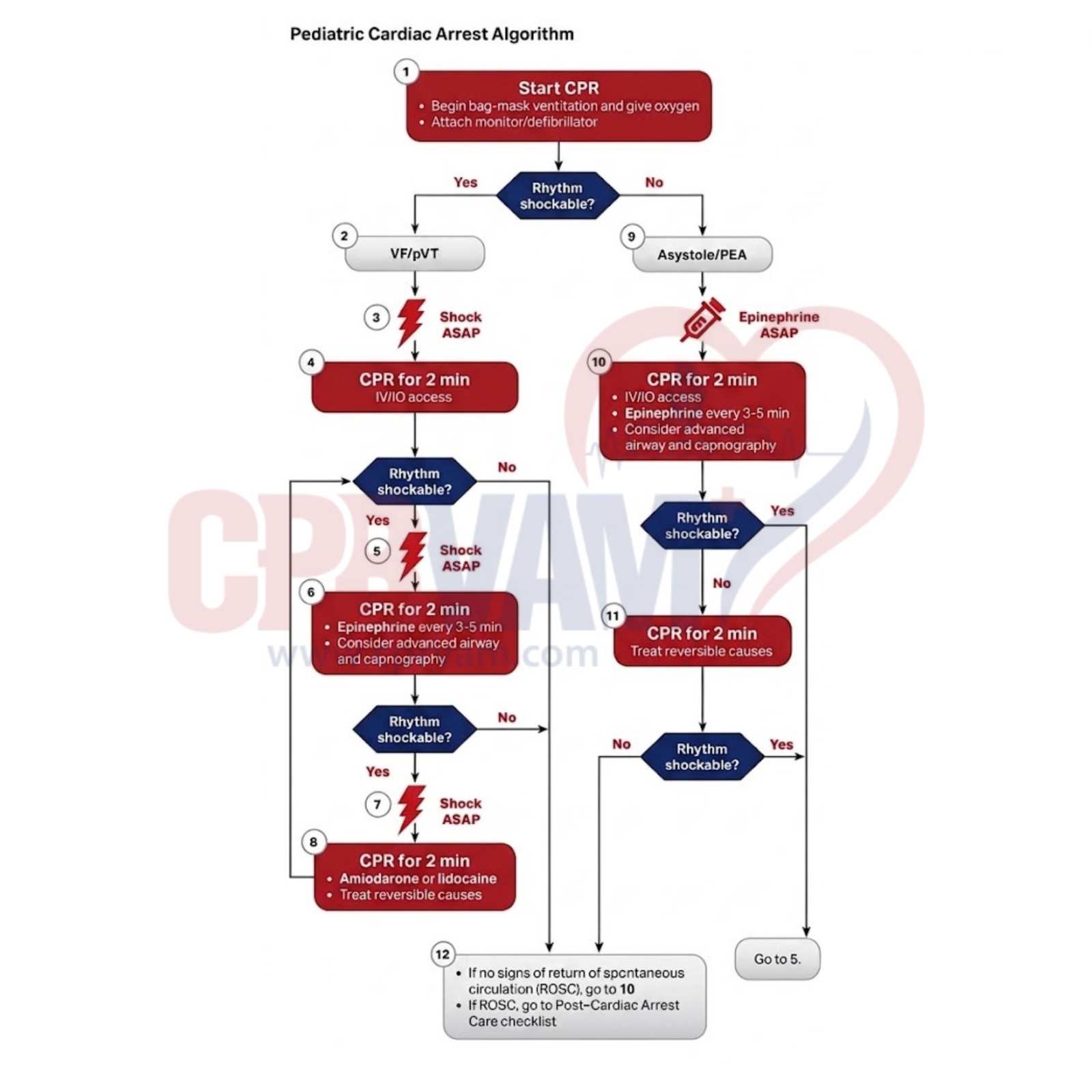
Pediatric cardiac arrest algorithm flowchart

Begin high-quality CPR without delay to maintain blood flow to vital organs. Quickly attach a monitor or defibrillator to identify the rhythm and guide further resuscitation management.

Main Steps:

  • Start chest compressions immediately
  • Provide effective oxygenation and ventilation
  • Connect the defibrillator/monitor early

Rapid rhythm evaluation determines whether the patient has VF/pVT or asystole/PEA. This step should be brief to avoid interrupting chest compressions for longer than necessary.

Important Focus:

  • Identify VF/pVT or asystole/PEA
  • Limit pause to 5-10 seconds
  • Guide treatment based on rhythm

2.1.1. Immediate Defibrillation

VF or pVT requires urgent defibrillation to stop abnormal electrical activity and restore a normal rhythm. Shock should be delivered immediately once confirmed.

Clinical Priorities:

  • Deliver shock without delay
  • Ensure safety during defibrillation
  • Resume CPR immediately after shock

2.1.2. CPR with IV/IO Access

After a shock delivery, continue CPR for 2 minutes while establishing IV or IO access. This ensures circulation support and readiness for medication administration.

Operational Steps:

  • Maintain 2-minute CPR cycles
  • Establish IV or IO access quickly
  • Reassess rhythm after each cycle

2.1.3. Repeated Defibrillation with CPR Cycles

If VF/pVT persists, continue cycles of defibrillation followed by CPR. This repetitive approach increases the chances of successful rhythm conversion.

Treatment Flow:

  • Shock followed by 2 minutes of CPR
  • Reassess rhythm after each cycle
  • Continue until the rhythm changes

2.1.4. CPR with Epinephrine and Airway Support

Epinephrine is administered every 3-5 minutes to improve perfusion during CPR. Advanced airway and capnography may support ventilation and monitoring.

Treatment Focus:

  • Administer epinephrine regularly
  • Consider advanced airway management
  • Use capnography when available

2.1.5. Antiarrhythmic Therapy and Reversible Causes

If VF/pVT continues, antiarrhythmic drugs like amiodarone or lidocaine are used. Simultaneously, reversible causes must be identified and corrected.

Management Priorities:

2.2.1. Early Epinephrine Administration

In non-shockable rhythms, epinephrine is started early to support circulation. Defibrillation is not indicated in these cases.

Clinical Emphasis:

  • Start epinephrine promptly
  • No role for defibrillation
  • Focus on perfusion support

2.2.2. CPR with Ongoing Medication

Continue CPR in 2-minute cycles while administering epinephrine every 3–5 minutes. This maintains blood flow during prolonged resuscitation efforts.

Treatment Approach:

  • Maintain continuous CPR cycles
  • Repeat epinephrine as scheduled
  • Ensure oxygenation and ventilation

2.2.3. Ongoing Assessment and Reversible Causes

Rhythm is reassessed every 2 minutes to detect any change. Continuous evaluation helps identify reversible causes and guide treatment adjustments.

Clinical Monitoring:

  • Reassess rhythm every 2 minutes
  • Treat reversible causes promptly
  • Switch to a shockable pathway if VF/pVT appears

The ROSC indicates restoration of effective heart function and circulation. Immediate transition to post-cardiac arrest care is required to stabilize the patient and prevent deterioration.

Post-ROSC Actions:

  • Begin post-cardiac arrest care
  • Monitor for recurrence of arrest
  • Support oxygenation and blood pressure

Post-resuscitation care starts right after return of spontaneous circulation (ROSC) and focuses on stabilizing the child and maintaining vital organ function. The priority is to ensure adequate oxygenation, circulation, and neurological support while closely monitoring for any deterioration.

It also involves identifying and treating the underlying cause of the cardiac arrest to prevent recurrence and reduce the risk of further complications affecting the heart, brain, and lungs.

Key Management Steps:

  • Ensure adequate oxygenation and controlled ventilation
  • Maintain normal blood pressure and treat hypotension promptly
  • Monitor heart rhythm and hemodynamic status continuously
  • Manage body temperature to protect brain function
  • Identify and treat the underlying cause of cardiac arrest
  • Prepare for intensive care transfer and ongoing monitoring
Pharmacologic management in pediatric cardiac arrest involves giving the right medications at the right time to support effective resuscitation. These drugs help improve blood flow to the heart and brain, manage dangerous heart rhythms, and correct underlying metabolic or electrolyte problems.

Overall, this approach strengthens the quality of resuscitation efforts and improves the chances of a successful outcome.

Here are the medications used in pediatric cardiac arrest:

1. Epinephrine

  • Improves coronary and cerebral perfusion during CPR
  • Given at 0.01 mg/kg IV/IO every 3-5 minutes
  • Supports return of spontaneous circulation (ROSC)

2. Amiodarone

  • Used for refractory VF and pulseless VT
  • Administered as 5 mg/kg IV/IO bolus, repeat if needed
  • Helps stabilize cardiac rhythm when shocks fail

3. Lidocaine

  • Alternative antiarrhythmics for ventricular arrhythmias
  • Initial dose 1 mg/kg IV/IO, repeat every 5-10 minutes as needed
  • Maximum total dose 3 mg/kg during resuscitation

Pediatric cardiac arrest care relies on fast recognition, effective CPR, early rhythm evaluation, prompt defibrillation when indicated, and treatment of reversible causes. The AHA 2025 PALS algorithm guides providers through a clear, evidence-based process from initial response to post-resuscitation care, helping improve survival and neurological outcomes in children.

CPR VAM Training Center supports this learning with practical, hands-on instruction led by experienced instructors, helping learners build real-world confidence in emergencies. Completing BLS, ACLS, and PALS certification programs further strengthens resuscitation skills, improves clinical decision-making, and prepares healthcare providers to deliver effective, life-saving care.

In children, cardiac arrest is most often triggered by breathing failure, severe infection, or trauma rather than primary heart disease. Identifying and correcting the underlying cause early can significantly improve survival outcomes.

Early recognition allows faster initiation of life-saving measures before complete circulatory collapse occurs. This reduces organ damage and increases the likelihood of successful recovery.

Continuous compressions help maintain minimal blood flow to the brain and heart when the child’s heart is not pumping effectively. Interruptions can reduce survival chances and worsen outcomes.

Defibrillation is used only when the heart shows specific abnormal electrical rhythms that can respond to shock therapy. It is combined with CPR and medications for better effectiveness.

Structured training helps healthcare providers practice real-life scenarios, improving speed, confidence, and accuracy during emergencies. It ensures better teamwork and more effective life-saving interventions.

Pediatric Advanced Life Support (PALS) Classes