



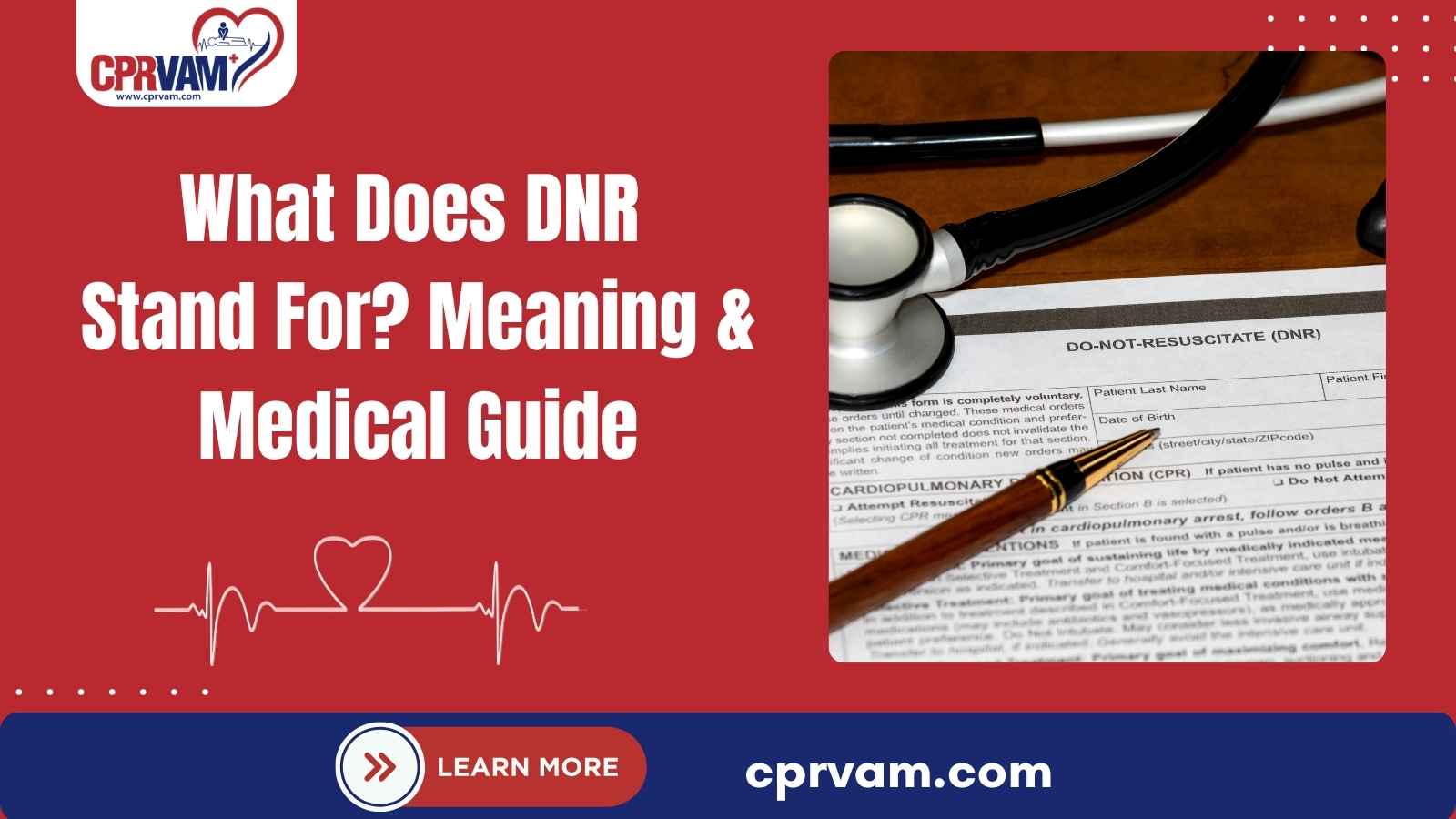
When you see “DNR” in a medical setting, it can raise an important question: What Does DNR Stand For? DNR means “Do Not Resuscitate” and refers to a medical order about whether CPR should be attempted if a person’s heart stops beating or breathing stops. The American Heart Association (AHA) addresses these decisions as part of patient autonomy, advance care planning, and shared decision-making.
Choosing a DNR does not alter daily patient management; ongoing medications, nursing assistance, and symptom relief remain standard procedure. Since DNR requirements can vary by state and healthcare system, understanding what the order covers and discussing it with a qualified healthcare professional can help ensure a person’s wishes are clearly understood and documented.
This blog explains what DNR stands for, what Do Not Resuscitate means, what a DNR covers, how it differs from related medical orders, and why clear documentation matters.
What Does DNR Mean in Healthcare?
In healthcare, DNR means “Do Not Resuscitate.” A DNR is a medical order that communicates a person’s wishes about CPR if their heart stops beating or they stop breathing. It helps healthcare professionals understand and follow those wishes when the person may not be able to communicate directly. Because a DNR specifically addresses cardiac and respiratory arrest, healthcare teams generally continue providing appropriate medical care for other conditions. In simple terms, a DNR answers one important question: Should CPR be attempted if cardiac or respiratory arrest occurs?
In healthcare, DNR decisions are often discussed as part of advance care planning. The American Heart Association’s 2025 CPR and ECC Guidelines emphasize patient autonomy, advance care planning, and shared decision-making when discussing resuscitation preferences. Since DNR requirements, documentation, and processes can vary by state and healthcare system, individuals should discuss their preferences with a qualified healthcare professional to understand how their wishes can be documented and followed.
What Does “Resuscitate” Mean?
Resuscitation means trying to restore vital functions when someone experiences cardiac arrest or respiratory arrest. In healthcare, resuscitation commonly includes CPR, which may involve chest compressions, rescue breaths, and other emergency interventions. The American Heart Association’s 2025 Basic Life Support Guidelines cover the recognition of cardiac arrest, high-quality CPR, and AED use, based on current resuscitation evidence and ILCOR recommendations.
In simple terms, when a medical order says “Do Not Resuscitate,” it means CPR should not be attempted under the circumstances covered by that order. Understanding what resuscitation means can make terms such as DNR, CPR, cardiac arrest, and advance care planning easier to understand, while the exact scope of a DNR depends on the applicable medical order and healthcare setting.
What Does a DNR Order Cover?
A DNR order covers whether CPR should be attempted if a person’s heart stops beating or breathing stops. It focuses on resuscitation and does not automatically mean that other medical care should stop. The specific instructions can vary based on the order, healthcare setting, and local requirements.
A person with a DNR may still receive:
- Medication for an existing condition
- Treatment for infections or other illnesses
- Oxygen and supportive care
- Pain and symptom management
- Diagnostic testing
- Nursing and comfort care
- Other treatments that match their wishes and medical orders
The key point is that a DNR addresses resuscitation, not all medical treatment. Because DNR rules and terminology can vary by location, patients should discuss their specific order with a qualified healthcare professional to understand what it covers.
What Does a DNR Not Mean?
One common misunderstanding is that DNR means “Do Not Treat.” It does not. A DNR generally addresses whether CPR and resuscitation should be attempted if cardiac or respiratory arrest occurs. A person with a DNR may still receive medical treatment, medications, pain and symptom management, nursing care, and comfort-focused care based on their wishes and medical needs.
A DNR also does not automatically determine decisions about other life-sustaining treatments. Choices about intubation, mechanical ventilation, and other interventions may be addressed separately through orders such as DNI, advance directives, or POLST. Understanding these distinctions can help patients and families better understand what a DNR order covers, while specific requirements may vary by state and healthcare setting.
DNR vs. DNACPR, DNI, Advance Directive & POLST
Several healthcare terms are related to DNR but have different meanings and purposes. Understanding these differences can help patients and families better understand resuscitation preferences, advance care planning, and medical orders.
Term | What It Generally Means |
DNR | Do Not Resuscitate: A medical order that addresses whether CPR should be attempted if cardiac or respiratory arrest occurs. |
DNACPR / DNAR | Do Not Attempt Cardiopulmonary Resuscitation / Do Not Attempt Resuscitation: Terms used in some healthcare systems to communicate that CPR or resuscitation should not be attempted. |
DNI | Do Not Intubate: An order indicating that endotracheal intubation should not be performed. Depending on the order, other decisions about mechanical ventilation may be addressed separately. |
Advance Directive | A broader legal document that communicates a person’s healthcare preferences and may identify someone to make healthcare decisions if the person cannot make them. |
POLST | Portable Medical Orders for Life-Sustaining Treatment: A medical order designed to communicate specific treatment preferences, including resuscitation preferences, for eligible patients. |
The American Heart Association (AHA) 2025 Ethics Guidelines explain the differences between DNR, DNACPR, advance directives, and POLST. In the United States, the AHA identifies POLST as a preferred way to document advance care plans related to CPR, while noting that requirements and use can vary by state and healthcare system.
Here’s a detailed comparison of the key differences:
DNR vs. DNACPR
DNR and DNACPR generally refer to the same basic decision: whether CPR should be attempted if cardiac or respiratory arrest occurs. DNACPR means “Do Not Attempt Cardiopulmonary Resuscitation” and is used in some healthcare systems instead of DNR, depending on local terminology and practice.
DNR vs. DNI
DNI means “Do Not Intubate.” Unlike a DNR, which focuses on CPR and resuscitation, a DNI addresses whether endotracheal intubation should be performed. A person may have a DNR, a DNI, or both, depending on their preferences and medical orders.
DNR vs. Advance Directive
An advance directive is broader than a DNR and can communicate a person’s healthcare wishes for future situations. It may include preferences about life-sustaining treatment and may name a healthcare agent or proxy to make decisions if the person cannot make them. A DNR specifically addresses CPR and resuscitation.
DNR vs. POLST
A POLST is a medical order designed to communicate specific treatment preferences that healthcare professionals can follow. Depending on the state and patient eligibility, a POLST can address CPR and other life-sustaining treatments, making it different from a broader advance directive.
The AHA notes that POLST forms can provide more specific treatment instructions than a general advance directive and can include resuscitation preferences as well as other medical interventions.
Why Would Someone Choose a DNR?
Choosing a DNR is a personal healthcare decision based on a person’s values, treatment preferences, health goals, and wishes about CPR and future medical care.
A person may consider a DNR for several reasons:
Personal Values
They may have specific beliefs or preferences about resuscitation and life-sustaining treatment.Quality of Life
They may want future care to focus on comfort, independence, or maintaining quality of life.Serious Illness
Someone with a serious or advanced illness may want their care to reflect their health goals and treatment preferences.Potential Burdens of CPR
They may decide that the possible burdens and risks of CPR do not fit with their goals of care.Advance Care Planning
A DNR can be part of a broader conversation about treatment choices and future healthcare decisions.
Having a DNR does not automatically mean a person is terminally ill or wants no medical treatment. The American Heart Association emphasizes patient autonomy and shared decision-making when discussing resuscitation preferences.
How Is a DNR Order Created or Changed?
Professional about their wishes for CPR and resuscitation. The healthcare professional then documents the decision according to applicable healthcare requirements and involves an authorized decision-maker when needed.
Talk About Your Wishes
Discuss whether you would want CPR and what matters most to you when making healthcare decisions.Consider Your Care Goals
Talk about your health, treatment preferences, quality of life, and goals for future care.Document the Decision
If a DNR is appropriate, the healthcare professional records the order in the medical record according to applicable requirements.Involve a Decision Maker When Needed
If a person cannot make healthcare decisions, an authorized surrogate or healthcare decision maker may be involved as permitted by law and policy.Review Your Preferences
Healthcare wishes can change as your health or circumstances change, so it can be helpful to review them over time.Change or Revoke a DNR
If you change your mind, discuss it with your healthcare professional so the order can be updated and properly documented.
MedlinePlus explains that healthcare providers document DNR orders after discussing the decision with the patient, proxy, or family as appropriate. The American Heart Association also recommends revisiting advance care planning because a person’s healthcare preferences may change over time.
Because DNR requirements can vary by state and healthcare system, your healthcare professional can explain how the process works in your specific situation.
Special Considerations for DNR Orders in Healthcare
DNR orders can apply differently depending on where a person receives care. Understanding how they may work outside a hospital or during surgery can help patients and families communicate their healthcare wishes clearly and understand what to expect in different situations.
Out-of-Hospital vs. In-Hospital DNR Orders
A DNR order may not be handled the same way in every healthcare setting. At home or in the community, emergency medical services (EMS) follow state laws and local protocols when determining whether a DNR or other medical order can be honored. Depending on the state, an approved out-of-hospital DNR form, POLST, or other recognized documentation may help communicate a person’s resuscitation wishes.
Because requirements can vary by state, patients should ask a healthcare professional which DNR documents or medical orders are recognized in their area. Keeping the appropriate documentation available can help emergency responders understand and follow a person’s documented healthcare preferences when possible.
DNR Orders During Surgery or Medical Procedures
A DNR order may need to be discussed before surgery, anesthesia, or certain medical procedures because some treatments used during these situations can overlap with resuscitation measures. For this reason, a DNR should not automatically be suspended when a person has surgery or another procedure.
Instead, the healthcare team should discuss the DNR with the patient or authorized decision maker and determine whether it should remain in place, be temporarily changed, or be suspended during the procedure. This conversation can include specific treatments, the patient’s preferences, and when the original DNR should take effect again.
Understanding DNR Orders and Making Informed Healthcare Decisions
Understanding a DNR order can make conversations about future healthcare clearer and more informed. A DNR focuses on CPR and resuscitation, while other treatment decisions may require separate orders or documents. If you are considering or reviewing your preferences, talk with a qualified healthcare professional about your goals, available options, and applicable requirements. Clear communication and accurate documentation can help ensure your healthcare wishes are understood and respected.
If you want to develop practical CPR skills, CPR VAM offers BLS, ACLS, PALS, and Heartsaver CPR courses for healthcare professionals, workplace teams, and community members. Explore CPR VAM training options and choose a course that fits your needs while building hands-on skills and confidence for emergency response.
FAQs About DNR
1. Does Having a DNR Mean Someone Is Dying?
No, having a DNR does not necessarily mean that someone is dying. A DNR reflects a person’s preferences about CPR and resuscitation. It does not by itself determine a person’s diagnosis, prognosis, or life expectancy.
2. Does a DNR Apply Everywhere?
Not necessarily, because DNR requirements can vary by state, healthcare system, and care setting. The form, terminology, and process for recognizing a DNR may differ depending on where care is provided. A healthcare professional can explain how a specific DNR order applies in that setting.
3. Is a DNR the Same as an Advance Directive?
No, a DNR is not the same as an advance directive. A DNR specifically addresses CPR and resuscitation, while an advance directive can cover broader healthcare preferences. An advance directive may also identify someone to make healthcare decisions if a person cannot do so.
4. Who Decides Whether a DNR Is Appropriate?
A DNR decision is usually made by the patient in discussion with a healthcare professional. If the patient cannot make healthcare decisions, an authorized surrogate or decision maker may be involved. The process depends on applicable laws, medical policies, and the person’s circumstances.
5. Can a DNR Be Part of Advance Care Planning?
Yes, a DNR can be part of broader advance care planning. It helps document a person’s preferences about CPR and resuscitation before an emergency occurs. Other documents or medical orders may address additional treatment preferences.